

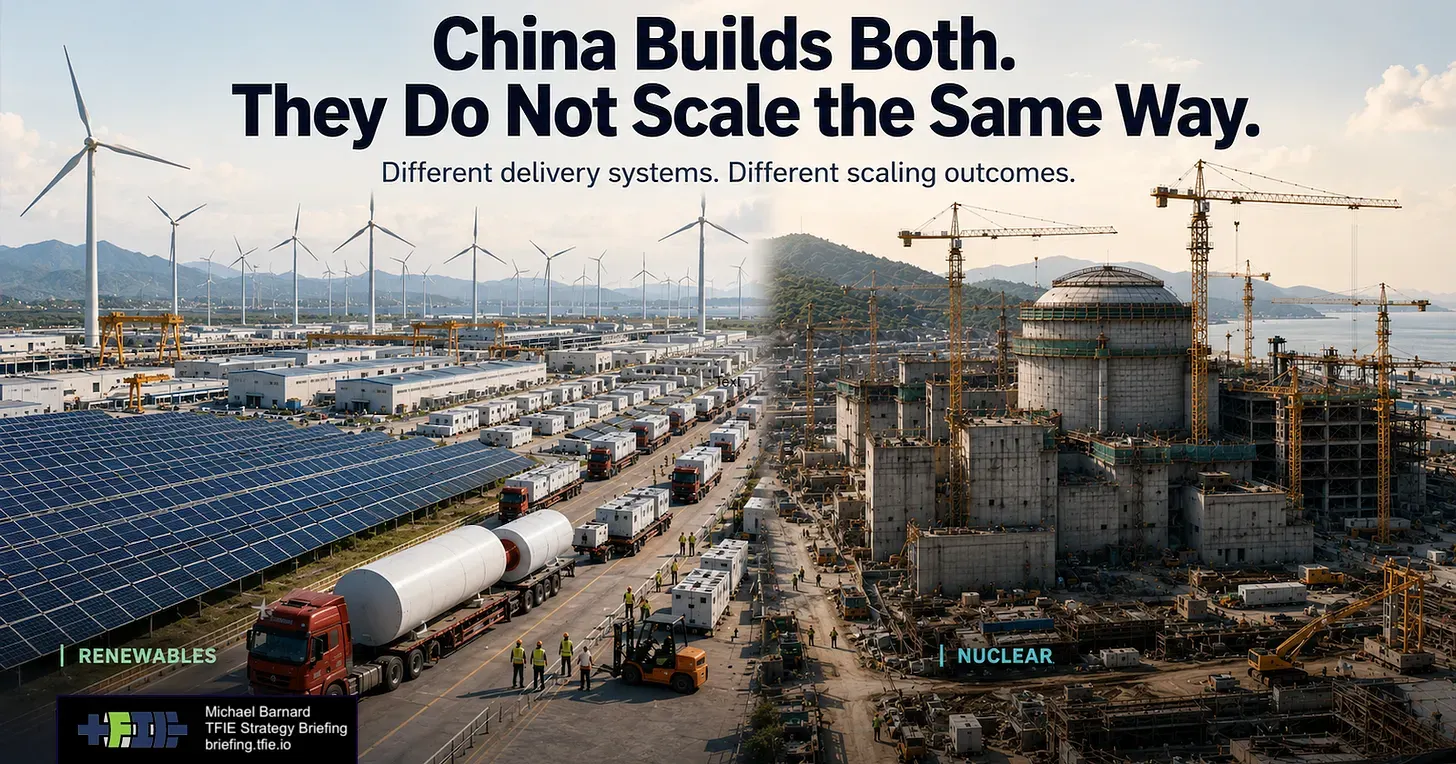
China’s renewable and nuclear energy targets have produced starkly different results, challenging assumptions that these commitments are equivalent indicators of future capacity. Wind and solar achievements have repeatedly surpassed targets by significant margins, while nuclear operating capacity has consistently fallen short despite continued construction and political backing.
The divergence in outcomes is particularly notable given China’s structural advantages in centralized planning, state-directed capital allocation, large developers and established supply chains. Between 2022 and 2025, new wind and solar capacity represented approximately 1,912 terawatt-hours of additional annual generation, compared with roughly 73 terawatt-hours from new nuclear capacity. This 26-to-1 ratio reflects a persistent pattern rather than isolated fluctuations. In 2025 alone, wind and solar additions represented about 696 terawatt-hours of annual generation capacity versus roughly 13 terawatt-hours from new nuclear.
The delivery mechanisms underlying these technologies differ fundamentally. Renewable energy capacity operates through industrial production systems where factories manufacture standardized components, developers assemble multiple projects in parallel, and installation crews work continuously across sites. Individual delays or setbacks have limited impact on national programs. Nuclear capacity, by contrast, arrives through a small number of long sequential projects, each requiring civil works, equipment installation, testing, fuel loading and grid connection. Design issues, approval pauses or component delays can affect significant portions of the program.
China’s nuclear sector remains active with the world’s largest reactor construction program and continued approvals. However, the gap between authorized capacity and operational capacity persists. The nation has established domestic supply chains around designs such as Hualong One, yet is building multiple variants rather than standardizing production, which limits repetition benefits. Future nuclear performance could improve with consecutive years of high reactor deliveries from repeated domestic designs, but this remains a forward-looking proposition rather than demonstrated capability.
Forecasters should calibrate expectations based on demonstrated delivery patterns rather than treating targets interchangeably. Renewable scenarios should be grounded in verified manufacturing and installation throughput, with constraints centered on grid absorption and storage capabilities. Nuclear forecasts should begin with the actual construction inventory, observed completion rates and project-specific risks, rather than assuming automatic conversion of approvals into operating capacity. Wind and solar targets warrant treatment as policy floors until integration data suggests otherwise, while nuclear targets remain aspirational pending concrete evidence of improved completion records from standardized designs.
Article Attribution | Read More at Article Source
Article summary produced by Claude AI