

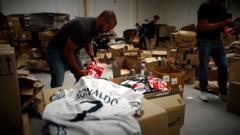
Law enforcement in the United Kingdom recovered more than 220,000 pieces of counterfeit football merchandise valued at over £18m during the World Cup period as part of Operation Bloxwich, a coordinated police effort targeting fake goods. The Police Intellectual Crime Unit conducted multiple raids, including one at a Birmingham warehouse that yielded 1,618 counterfeit shirts featuring replicas of prominent players.
Fire and rescue officials raised serious safety concerns about the counterfeit merchandise. Testing conducted by Cheshire Fire and Rescue Service compared the flammability of fake kits with authentic versions, finding the counterfeit items significantly more prone to ignition and melting. Officials demonstrated that counterfeit shirts caught fire rapidly when exposed to open flame, while genuine kits required substantially more effort to ignite. Watch manager Dave Jackson, who performed the comparative tests, emphasized the potential for serious injuries, particularly to children.
Experts attributed the proliferation of counterfeit merchandise to pricing disparities between fake and genuine products. Counterfeit shirts were available for purchase online for as little as £12, while authentic Premier League replica kits could cost £85 or more—up to seven times the price of counterfeits. Detective Sergeant Jamie Kirk of City of London Police noted that while the lower cost attracts consumers, the unregulated nature of fake products poses multiple hazards, including potentially harmful dyes that may cause skin irritation, especially in children.
Kate Caffrey, head of intelligence at the Intellectual Property Office, stressed that counterfeit strips operate outside established health and safety frameworks. She indicated that fake merchandise is produced under uncontrolled conditions by criminal networks and distributed without safety verification. Officials warned that counterfeit markets would likely expand during high-demand periods such as the upcoming Premier League season.