

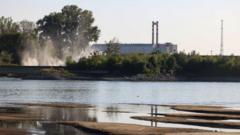
Hungary’s sole nuclear facility at Paks will cease operations entirely, according to Prime Minister Péter Magyar, after water levels in the River Danube fell to critically low levels, rendering the plant’s cooling system inoperable. The facility has historically relied on the river for temperature regulation, but current conditions prevent the suction mechanisms from accessing sufficient water.
Magyar cautioned that the nation’s energy situation could deteriorate significantly starting Monday, coinciding with extreme heat expected to persist for approximately one week, with temperatures anticipated near 37 degrees Celsius. The government has requested residents voluntarily reduce energy consumption during peak evening hours between 17:00 and 22:00, particularly for activities such as vehicle charging and air conditioning use. Officials also indicated that rolling blackouts could become necessary if voluntary measures prove insufficient to maintain grid stability, with plans to identify essential services whose electricity and water supply might require regulation.
Romania faces comparable challenges, having already shut down one of two nuclear reactors at the Cernavoda facility, which normally supplies roughly one-fifth of the nation’s electricity. Officials were attempting to prevent closure of the second reactor. The Danube’s water flow has dropped dramatically, with measurements showing levels at approximately one-third of typical July averages, with projections indicating further decline.
Much of Europe is experiencing severe drought conditions coupled with elevated temperatures. Danube water levels have declined to their lowest point in decades across multiple nations, including Serbia and Romania. The extended dry conditions and heat have revealed submerged artifacts, including remains of a Hungarian cargo vessel in Croatia and historical military equipment in Serbia. River transportation has halted in portions of Bulgaria, and authorities evacuated passengers from a stranded cruise ship. Officials noted current conditions represent levels unseen for multiple decades, with climate scientists predicting no improvement until mid-September.
Article Attribution | Read More at Article Source
Article summary produced by Claude AI