

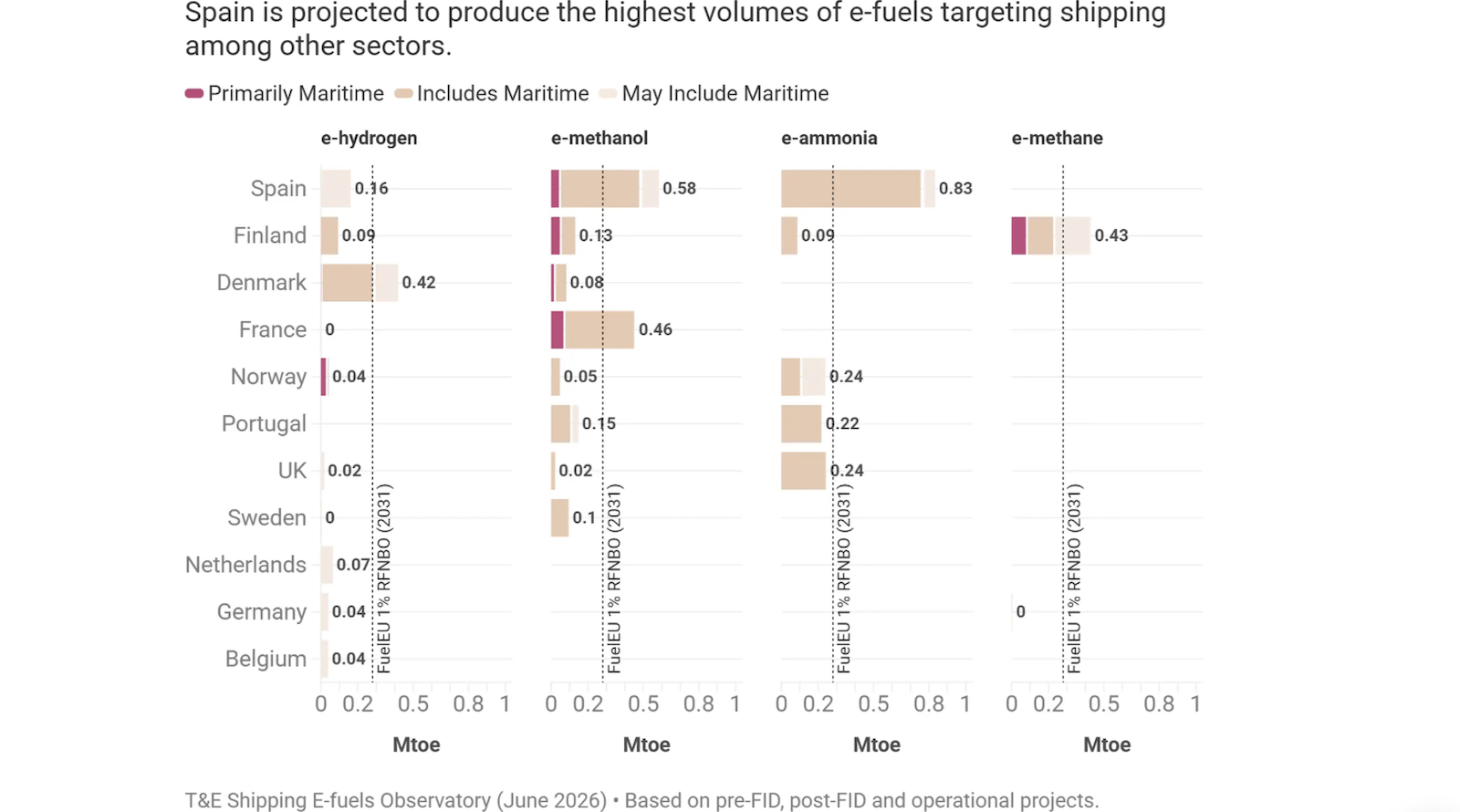
Europe has developed 69 projects designed to produce e-fuels for the maritime sector, yet only six have begun operations, according to tracking data cited by transport advocacy organization T&E. If all proposed projects were to reach full operational status, combined production capacity could reach approximately 4.09 million tonnes of oil equivalent annually by 2033, potentially meeting roughly 14 percent of European shipping’s fuel requirements.
The landscape of e-fuel development varies across European nations, with Spain emerging as the leading developer of such projects, followed by Denmark, Finland, and France. Recent progress includes the Andalusian Green Hydrogen Valley project achieving final investment decision in February, with plans to produce 474,000 tonnes per year of e-ammonia and e-methanol. Despite these developments, the pace of project implementation remains gradual.
Meanwhile, China currently operates three e-fuel production facilities that are generating output at rates ten times higher than Europe’s operational plants, according to T&E’s analysis. This disparity in production capacity has prompted concerns about Europe’s competitive position in what is characterized as a strategically important emerging market. There is concern that Chinese production could saturate European markets without equivalent local competition.
T&E’s maritime policy manager noted that regulatory action and financial incentives would be necessary to accelerate European project development. Specific recommendations include establishing e-fuel targets at the EU level, implementing effective financial support mechanisms, and narrowing the price differential between EU-produced e-fuels and conventional fossil fuels. Transport advocates argue that without such measures, shipping companies may continue defaulting to imported liquefied natural gas or biofuels rather than adopting locally produced e-fuel alternatives.
Article Attribution | Read More at Article Source
Article summary produced by Claude AI