

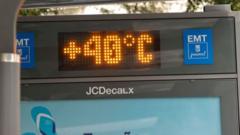
On 23 June, France experienced one of its hottest days on record, with temperatures around 40 degrees Celsius in some regions. In the Brittany town of Ergué-Gabéric, an electrical transformer operated by power company RTE malfunctioned due to the extreme heat, initially cutting power to more than 100,000 residents. Videos shared on social media appeared to show smoke emanating from the facility.
The incident highlights a broader concern: technological systems across multiple sectors have performance limitations when exposed to high temperatures. Electrical equipment, telecommunications infrastructure, and railway signalling systems all experience degradation during heatwaves. Researchers at Imperial College London note that gas-fired power stations see roughly 10 percent output reduction at 40 degrees Celsius compared to 20 degrees. Solar panel efficiency also declines with temperature, though newer generations show less pronounced effects. Power transmission lines present particular challenges, as metal cables expand in heat and sag under their own weight, potentially contacting trees or buildings below and creating fire or outage risks. Operators must reduce electricity transmission capacity during heatwaves to prevent such incidents.
Recent incidents demonstrate real-world consequences. During a July 2022 heatwave in the United Kingdom, overheating caused widespread power cuts. Data centre cooling systems failed at major London hospitals, forcing the cancellation of surgical operations when internal temperatures reached dangerous levels. Additional complications include thermal effects on computer processors and circuit boards, where excessive heat can cause microscopic metal connections to crack and increase data transmission errors. Motion sensors in security systems sometimes misfire when room temperatures shift rapidly.
Telecommunications and railway infrastructure face particular vulnerability. Metal cabinets housing signalling and communications equipment can exceed 70 degrees Celsius during heatwaves. Operators have responded by adding ventilation, shielding, and in some cases trialling liquid-based cooling systems. However, experts assess the risk of widespread communications failures as relatively low, noting that many households have broadband capacity significantly exceeding actual requirements.
With climate change driving more frequent and intense heatwaves, infrastructure adaptation has become increasingly urgent. The UK’s independent Climate Change Committee warned that widespread outages from extreme heat could impact digital payments, transportation, and public services, potentially costing billions of pounds. Engineers are implementing various resilience strategies, including improved cooling systems and network capacity expansion, though experts emphasize that substantial infrastructure modifications will be necessary to maintain reliability as temperatures continue rising.
Article Attribution | Read More at Article Source
Article summary produced by Claude AI