

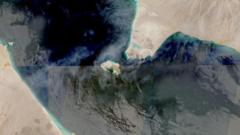
Yemen’s Houthi fighters have conducted attacks on vessels transiting the Red Sea, forcing ships away from the Bab El Mandeb strait, a narrow waterway that serves as a principal shipping corridor between Europe and Asia. Two Saudi vessels sustained missile damage this week, and the Houthis claim to have diverted approximately 10 additional ships after warning them against approaching Saudi ports.
The attacks occur amid an intensifying conflict between the United States and Iran. US Central Command has conducted air strikes on Iranian coastal installations for 12 consecutive nights, targeting radar, drone, and missile bases. The Gulf Arab states face mounting pressure from Iranian drone and ballistic missile attacks. Saudi Arabia had partially offset disruptions caused by Iran’s effective closure of the Strait of Hormuz by routing oil exports through its internal East-West Pipeline to the Red Sea terminal at Yanbu’ Al-Bahr, then shipping by tanker through the Bab El Mandeb Strait. The Houthi campaign now threatens this alternative export route.
The Houthis, an Iran-backed Shia group from northern Yemen, took control of the capital Sanaa in 2014 and have since consolidated power across much of the country, including the strategic port of Hodeidah. Saudi Arabia launched a military campaign against them in 2015, but despite superior air power and years of bombardment causing significant civilian casualties, the Houthis have remained entrenched. From 2023 through 2025, they conducted a sustained campaign against shipping they identified as Israeli-linked, claiming solidarity with Palestinians in Gaza.
The escalating disruptions to maritime trade raise concerns about global economic impacts. With both the Strait of Hormuz and potentially the Bab El Mandeb Strait facing restrictions, essential products including Gulf oil, gas, and fertilizer face increasing difficulty reaching international markets. Additionally, an announced agreement between the United States and Saudi Arabia to develop Saudi nuclear power capacity has prompted concerns about potential regional nuclear proliferation, with analysts worried Turkey and Egypt may accelerate their own nuclear programs. Without a comprehensive resolution between Washington and Tehran, analysts warn the region faces an extended period of instability.
Article Attribution | Read More at Article Source
Article summary produced by Claude AI