

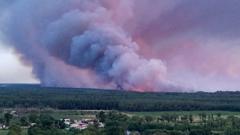
Tens of thousands of residents have been evacuated from the Gironde region surrounding Bordeaux as French authorities combat wildfires intensified by pyrocumulonimbus phenomena, commonly known as fire-generated thunderstorms. French firefighting officials have indicated this represents the first occurrence of such conditions in the country.
These unusual clouds form through a distinct meteorological process triggered by wildfire intensity. The extreme heat from burning vegetation causes air above the fire to rise rapidly, carrying smoke, ash, and water vapor into the upper atmosphere. As this air mass ascends and cools, water vapor undergoes condensation, forming cloud structures. When conditions are sufficiently extreme, these clouds develop into towering cumulonimbus formations—the same cloud type associated with conventional thunderstorms. The phenomenon requires particularly dangerous atmospheric conditions including elevated temperatures, powerful winds, and low moisture levels.
Fire-generated thunderstorms create significant operational challenges for emergency responders. Turbulent wind patterns generated by these clouds disperse burning embers across broad areas, rendering fires increasingly unpredictable and difficult to suppress. Lightning generated within the clouds can ignite additional fires, further expanding affected areas. Officials involved in the response have warned that the Gironde wildfire may burn for many weeks and require months for complete extinguishment. Weather forecasts indicating another heatwave later this week with temperatures potentially reaching 40C may further complicate containment efforts.
Across Europe, summer conditions have featured intense heat with minimal precipitation, creating ideal conditions for wildfire propagation in France, Spain, and the UK. Scientific research suggests climate change will likely increase the frequency of such pyrocumulonimbus events. While once considered relatively uncommon, similar phenomena occurred during Australia’s 2019-2020 Black Summer bushfires and California’s 2021 wildfire season, both producing extreme conditions and substantial casualties.
Article Attribution | Read More at Article Source
Article summary produced by Claude AI