

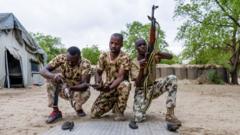
Nigeria’s President Bola Tinubu has authorized a significant military expansion involving the recruitment of 28,000 additional soldiers and the establishment of four new army divisions, bringing the total number of divisions to 12. The decision reflects efforts to address ongoing security threats from multiple armed groups operating across the nation, including militant Islamists, separatist movements, and criminal gangs engaged in kidnapping and banditry.
The country has faced intensifying violence despite some recent tactical successes. Within the past week alone, an armed gang killed at least 20 residents in Zamfara state in the north-west, and 46 students were abducted from a school in Borno state in the north-east before being rescued by military forces. In May, coordinated school attacks in Oyo state in the south-west resulted in the abduction of 44 pupils and teachers. Security challenges have become increasingly sophisticated and now extend into southern regions previously less affected by such violence.
Government officials stated that the new divisional structure would improve coordination, intelligence sharing, and operational response times. Under the existing framework, individual divisions have struggled to maintain security across expansive territorial areas spanning multiple states with limited resources. The expansion plan also includes establishing three new army headquarters in the north-east and central regions, areas heavily affected by Islamist extremists, bandit networks, and farmer-herder conflicts.
Security analysts have raised concerns about recruitment sustainability, noting that the substantial number of military personnel killed in recent combat operations may deter young Nigerians from enlisting. President Tinubu previously issued an ultimatum to armed groups, demanding they “surrender or face the full force” of the state. Beyond military expansion, the government announced plans to hire more than 50,000 police officers and allocated a record 5.41 trillion naira to defense and security in the annual budget.
International efforts to combat extremism have included a joint US-Nigerian operation, which concluded early this month, targeting jihadist groups including the Lakurawa faction in the north-west and resulting in the elimination of Islamic State leader Abu-Bilal al-Minuki. However, despite these operations, Islamist militant activities continue across the region, with analysts noting that approximately 90 percent of Islamic State attacks globally now occur in sub-Saharan Africa, with Nigeria’s branch being the most active.
Article Attribution | Read More at Article Source
Article summary produced by Claude AI