

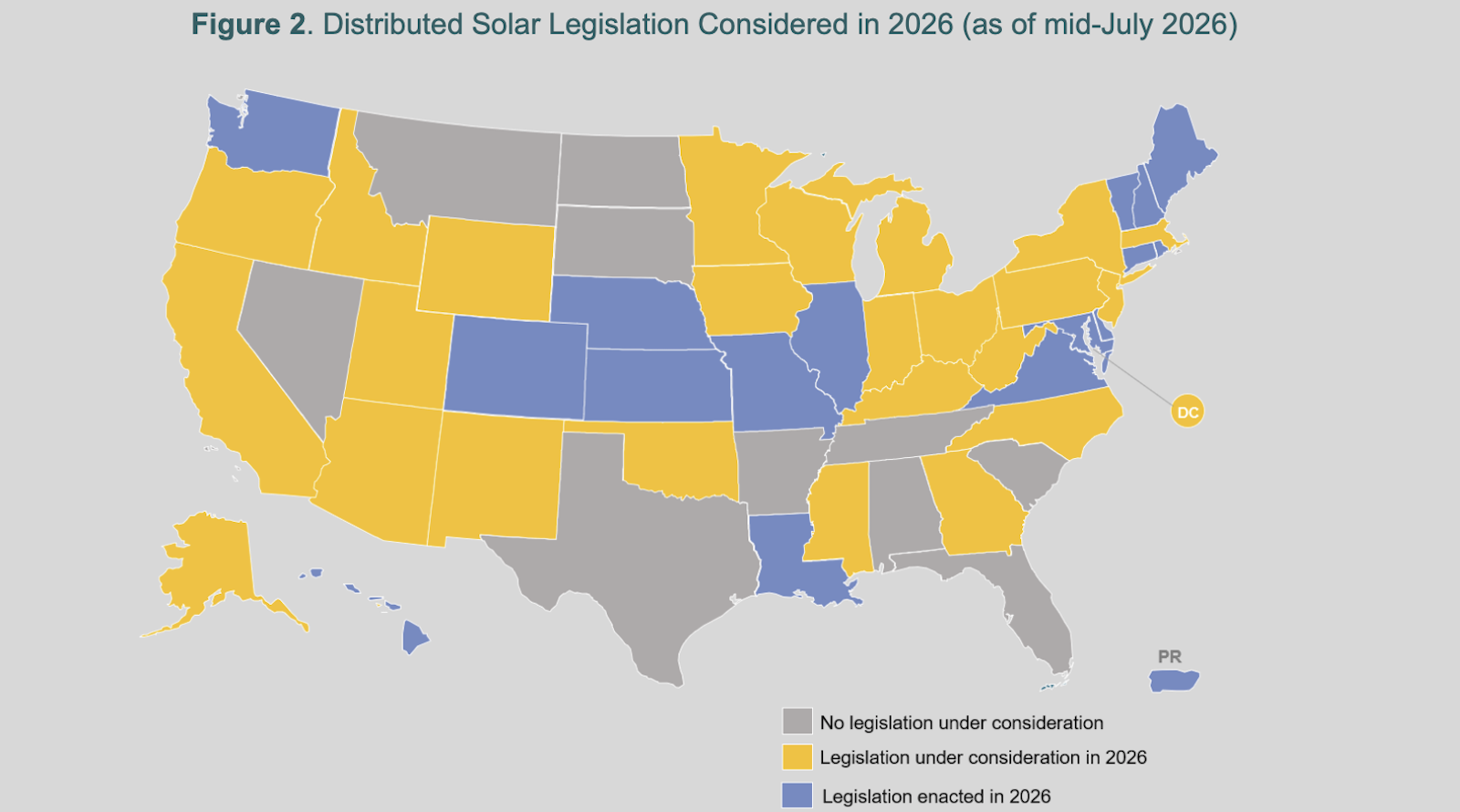
The NC Clean Energy Technology Center released its quarterly assessment of state-level distributed solar policy developments during the second quarter, examining regulatory and legislative activities across the nation. The report documents a total of 284 policy actions undertaken during the period, with participation spanning 45 states along with the District of Columbia and Puerto Rico. Illinois, Maryland, New Jersey, Virginia, New Hampshire, Connecticut, Maine, and Rhode Island led in the number of actions taken during the quarter.
Three dominant policy trends emerged during the period. Legislators in multiple states advanced proposals authorizing plug-in solar installations, with approximately half of all states considering bills designed to reduce regulatory requirements for these systems. Policy makers also focused on balancing the financial implications of distributed generation programs, while numerous states pursued improvements to interconnection procedures for both residential and public sector customers.
Net metering policies received the most attention among specific policy categories, with 53 related actions documented. Community solar programs and residential fixed charge or minimum bill structures followed closely, each generating 48 and 45 actions respectively. The report covers additional policy areas including distributed solar valuation methods, interconnection rules, residential demand and solar charges, financial incentives, and third-party ownership arrangements.
Senior leadership at the center highlighted the surge in plug-in solar legislation as particularly significant, noting broad geographic interest in reducing barriers for customers unable to access conventional solar installations. Separately, officials pointed to efforts by states to address cost allocation issues as distributed generation and net metering expand, emphasizing the need to prevent cost shifting between participating and non-participating utility ratepayers through mechanisms including revised cost recovery approaches and program restructuring.
Article Attribution | Read More at Article Source
Article summary produced by Claude AI