

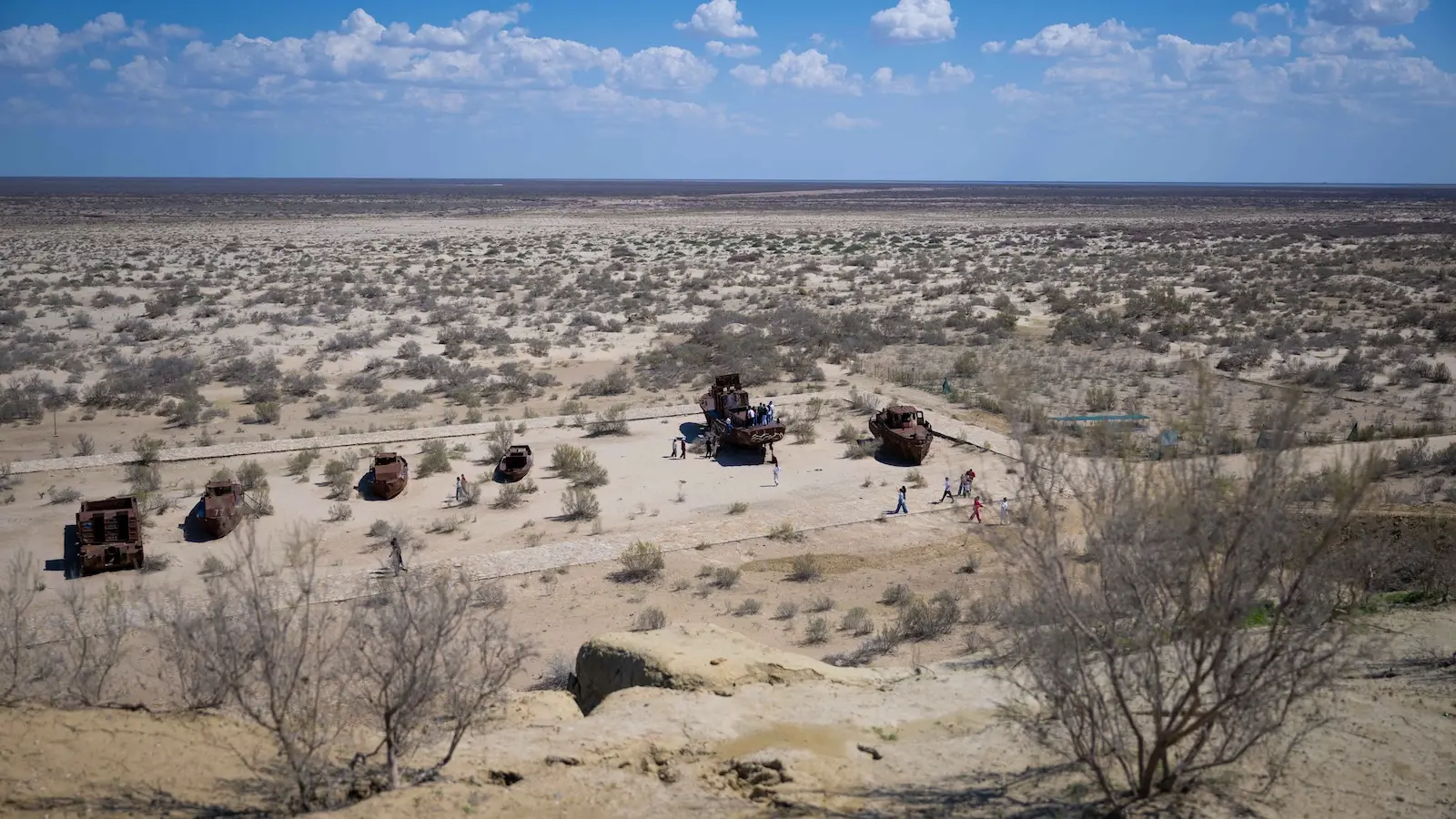
The Aral Sea, situated between Kazakhstan and Uzbekistan and once the world’s fourth-largest inland body of water, has been progressively drained over the past 60 years through irrigation diversions for cotton cultivation. A study published this week in the journal Science documents how this environmental transformation has created an unexpected climate consequence by releasing stored carbon into the atmosphere.
When water bodies function normally, organic matter accumulates in sediments where carbon remains sequestered for extended periods. However, as the Aral Sea dried, this trapped carbon was released back into the atmosphere. Researchers led by Rafael Marcé of the Centre for Advanced Studies in Blanes, Spain conducted fieldwork in 2022, collecting samples across the lake’s drying gradient to reconstruct historical carbon emissions. Their analysis found that between 1960 and 2022, the Aral Sea released approximately 748 million metric tons of carbon dioxide—equivalent to three times Spain’s annual emissions. About half this release occurred within the first 15 years after each section dried, with an additional fifth coming from wind-blown sediment carrying carbon away.
The study has limitations that could affect its conclusions. Equipment constraints restricted sediment sampling to 50 centimeters depth, while the actual lake bed extends many feet deeper. Marcé noted this could mean current calculations underestimate total carbon release. The research team plans to return with more substantial drilling equipment to better understand carbon dynamics in deeper sediment layers.
The Aral Sea is not unique in this phenomenon. Other water bodies experiencing similar drying, including Lake Chad in Africa, Bolivia’s Lake Poopó, and North America’s Great Salt Lake and Salton Sea, are also releasing previously unmeasured quantities of carbon. The Caspian Sea, the world’s largest inland water body, is projected to shrink by an area larger than the entire Aral Sea by century’s end. Scientists increasingly recognize this “dry flux” represents a significant blind spot in carbon accounting.
The research also identifies potential mitigation pathways. The study estimates approximately 605 million metric tons of carbon dioxide remains sequestered in the Aral Sea’s sediments. Protecting this stored carbon could provide the equivalent of roughly $18 billion in carbon credits, potentially offering economic incentives for restoration efforts. While reversing the Aral Sea’s desiccation would require coordinating multiple jurisdictions and modernizing outdated irrigation infrastructure, researchers suggest linking such restoration to carbon credit frameworks could facilitate solutions.
Article Attribution | Read More at Article Source
Article summary produced by Claude AI