

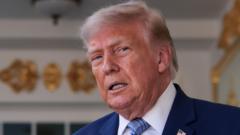
President Trump declared that the United States would initiate an investigation into the European Union’s regulatory practices regarding American technology companies and warned of potential tariff actions in response.
The announcement followed the European Commission’s recent €890 million fine against Google for allegedly engaging in anticompetitive conduct. Trump stated on Truth Social that the EU would face significant consequences for its treatment of Google and other major US tech firms including Apple, Meta, and Amazon. He demanded that all fines be reversed and indicated plans to launch a Section 301 trade investigation, which would enable the US Trade Representative to examine whether the EU’s regulatory practices constitute unfair trade conduct. Trump characterized the fines as a form of extraction from American companies and their taxpayers, declaring that “The United States of America is not a ‘PIGGYBANK’ for Europe.”
The tariff threat escalated recent tensions between the two trading blocs. The previous day, Trump had announced new tariffs ranging from 10% to 12.5% on approximately 60 trading partners, including the EU, United Kingdom, and China. Earlier in the month, he had also threatened 100% import tariffs on any European nation adopting digital services taxes targeting American technology companies.
Google stated it had worked to comply with European regulations while expressing concerns about recent decisions by the European Commission. The company welcomed engagement from the US administration. Representatives from Meta, Apple, Amazon, and the European Commission were contacted for comment but had not yet responded at the time of reporting.
Trump cited specific fine amounts in his statement, claiming Apple had received €15 billion in EU penalties, Meta €3 billion, and Amazon €2.5 billion, though the sources for these figures were unclear. Historical context indicated that Meta and Apple had previously received significant fines from European regulators, while Amazon had faced investigations and settlements but avoided major penalties until a separate regulatory body in Luxembourg imposed a fine that was later overturned.
Article Attribution | Read More at Article Source
Article summary produced by Claude AI