

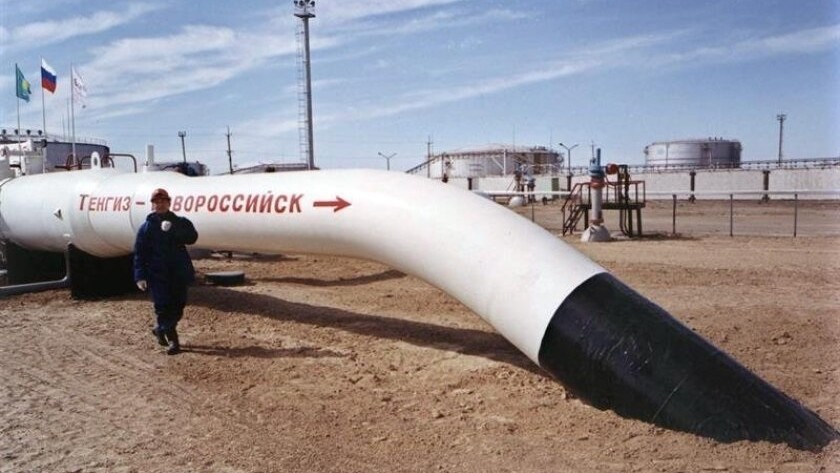
Kazakhstan faces mounting challenges to its oil export capacity despite theoretical advantages from Russia’s energy isolation, primarily due to geographic vulnerabilities and dependence on aging Soviet-era infrastructure. The country’s crude oil is currently unsanctioned and sought by European refiners needing alternatives to Russian barrels, yet recurring disruptions are limiting its ability to capitalize on this opportunity.
The Caspian Pipeline Consortium represents the critical vulnerability in Kazakhstan’s export system. This pipeline transports crude over 1,500 kilometers from Kazakhstan’s Tengiz field and other western producers to a Black Sea terminal near Novorossiysk, Russia, carrying approximately 1.7 million barrels per day with about 80 percent of Kazakhstan’s total crude exports flowing through this single route. The concentration of exports through one corridor proved manageable during stable periods but has become increasingly precarious due to the Ukraine conflict. Ukrainian drone strikes have repeatedly targeted the Novorossiysk terminal region and vessels associated with CPC loadings, with a significant strike in November 2025 damaging critical moorings. By July 21, the pipeline halted crude intake following suspended loadings, with no full restart confirmed by July 23. Commercial activity has effectively ceased as tanker operators and major producers refuse to call at the terminal due to security concerns.
Europe faces particular exposure from this disruption, with Italy’s Trieste port receiving approximately 300,000 barrels per day of CPC exports that supply refineries in Austria, Czech Republic, Germany, France, the Netherlands, Spain and Greece. The crude grade presents additional complications, as CPC Blend is relatively sour at 0.6 percent sulfur content, requiring specific desulfurization capacity that alternative suppliers cannot easily replace.
Kazakhstan’s alternative export routes prove insufficient to compensate for CPC disruptions. The Atyrau-Samara pipeline into Russia’s system handled only 220,000 barrels per day against 350,000 barrel per day capacity in 2025, while the Kazakhstan-China pipeline already carries integrated regional flows. The Caspian Sea route through Baku to the Baku-Tbilisi-Ceyhan pipeline currently manages only 30,000 barrels per day due to shallow waters limiting vessel size and insufficient port infrastructure. Even planned expansions to 140,000 barrels per day would address only a fraction of typical CPC volumes.
Beyond transportation constraints, Kazakhstan’s production faces internal pressures. The Karachaganak field depends on Russian processing facilities, with a June 24 drone strike on Orenburg reducing its output by approximately 70,000 barrels per day. The Tengiz field has experienced recurring operational disruptions, with a January incident cutting production from 900,000 to 360,000 barrels per day and recent May incidents causing additional sharp declines. Current production stands at 1.63 million barrels per day compared to July averages of 2.07 million barrels per day, representing significant capacity loss.
Article Attribution | Read More at Article Source
Article summary produced by Claude AI