

Hamas announced its acceptance of a weapons disarmament plan for Gaza as part of broader peace negotiations overseen by a U.S.-led Board of Peace. The Palestinian faction stated it had engaged in negotiations “responsibly and positively” and achieved consensus among Palestinian groups. President Trump characterized the development as significant progress toward establishing lasting peace and security in the region.
The disarmament framework includes a 15-point roadmap issued by the Board of Peace, supplemented by a four-page implementation document detailing phased Hamas weapons surrender and corresponding Israeli military withdrawal. The process would inventory and secure heavy weapons, military production facilities, weapons caches, and underground tunnel networks, conditional on Israel meeting its commitments under an October ceasefire agreement. The Palestinian National Committee, comprised of independent technocrats to which Hamas agreed to transfer authority, would oversee the process alongside an International Stabilisation Force deployed to Gaza. The document specifies that weapons would not be transferred to Israel or non-Palestinian entities, though the precise mechanics of weapons storage and transfer remain unclear. Implementation is described as occurring in a “gradual, sequential, and time-bound manner” with scheduling details to be finalized within 14 days.
Light and personal weapons would be registered and transferred progressively to a new Palestinian police force operating under International Stabilisation Force supervision. Hamas has sought assurances that pro-Israel armed groups in Gaza would similarly disarm. Israel remains deeply skeptical of Hamas’s willingness to relinquish weapons or territorial control, with some Israeli officials rejecting the plan outright. Israeli leadership has stated no withdrawal would occur from the Yellow Line demarcation zone until Hamas disarmament is confirmed, though Israel currently controls approximately 60 percent of Gaza, exceeding the 53 percent established under the October ceasefire terms.
Hamas announced earlier this month that it dissolved its Gaza government and would transfer power to the National Committee. The agreement addresses compensation and employment for tens of thousands of civil servants previously employed by Hamas, including security personnel and healthcare and education workers, stipulating fair and dignified treatment regarding worker rights. Hamas appointed Khalil al-Hayya as overall leader, consolidating decision-making authority that was previously distributed among five council members.
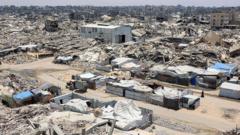
Despite the announcement, reception in Gaza has been subdued, with many Palestinians expressing skepticism following years of failed ceasefire agreements. Over two million Palestinians currently face severe humanitarian conditions involving disease, food scarcity, inadequate water access, and insufficient shelter. Since the October ceasefire commenced, at least 1,168 Palestinians including children have been killed in Israeli military operations according to Hamas health ministry figures deemed reliable by the United Nations, while four Israeli soldiers have been killed in Palestinian attacks.
Article Attribution | Read More at Article Source
Article summary produced by Claude AI