

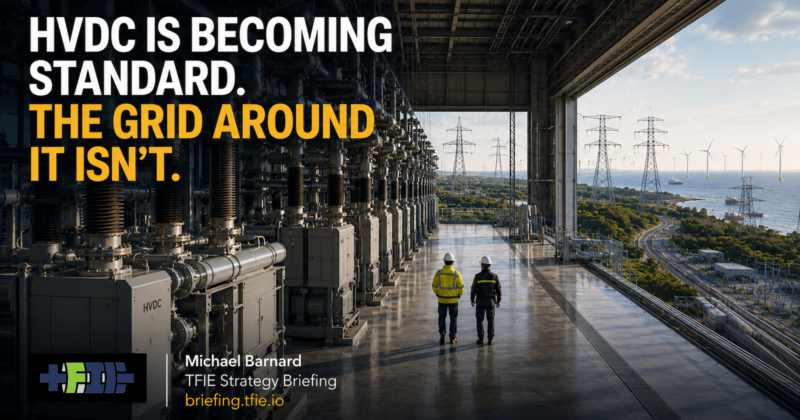
High-voltage direct current transmission has shifted from a niche technology for specialized applications toward mainstream use in grid planning. According to GE Vernova’s chief technology officer, the European market is converging on 2 GW, 525 kV HVDC systems with standardized converter configurations and bipolar designs. The United States and India are developing similar standards at 3 GW capacity. This physical standardization enables manufacturers, suppliers, and developers to build repeatable product families rather than engineering custom solutions for each project.
However, the electrical systems surrounding these standardized components are not advancing at the same pace. As conventional power generators retire and more renewable energy sources connect through power electronic converters, transmission systems must increasingly provide grid stability beyond simply transmitting bulk electricity between locations. Grid-forming controls are becoming standard requirements for HVDC converters, but no unified global definition currently exists for how these controls should operate. Requirements vary by regional grid codes, forcing vendors to maintain different implementations and leaving utilities to manage system interactions on a case-by-case basis.
The challenge intensifies as European grids transition from point-to-point HVDC links toward multi-terminal and multi-vendor configurations. Equipment from different manufacturers must operate seamlessly together, requiring alignment on control modes, protection systems, interfaces, and intellectual property arrangements. This coordination extends beyond technical compatibility to encompass planning infrastructure, cost allocation, and regulatory frameworks. North America faces particular weakness in inter-regional planning and institutional coordination compared to Europe’s established multinational grid planning mechanisms.
Beyond manufacturing and technical standardization, the industry confronts additional constraints in experienced power engineers. While standard designs can reduce engineering hours per project and artificial intelligence may automate certain tasks, grids dominated by inverter-based resources require personnel with specialized knowledge of control systems, protection, high-voltage technology, and system behavior. According to industry assessments, workforce capacity represents one of the sector’s most significant practical limitations currently facing deployment. The remaining barriers to widespread HVDC deployment now center on system architecture, interoperability protocols, cross-border planning coordination, and project execution across institutional boundaries rather than hardware manufacturing capability.
Article Attribution | Read More at Article Source
Article summary produced by Claude AI