

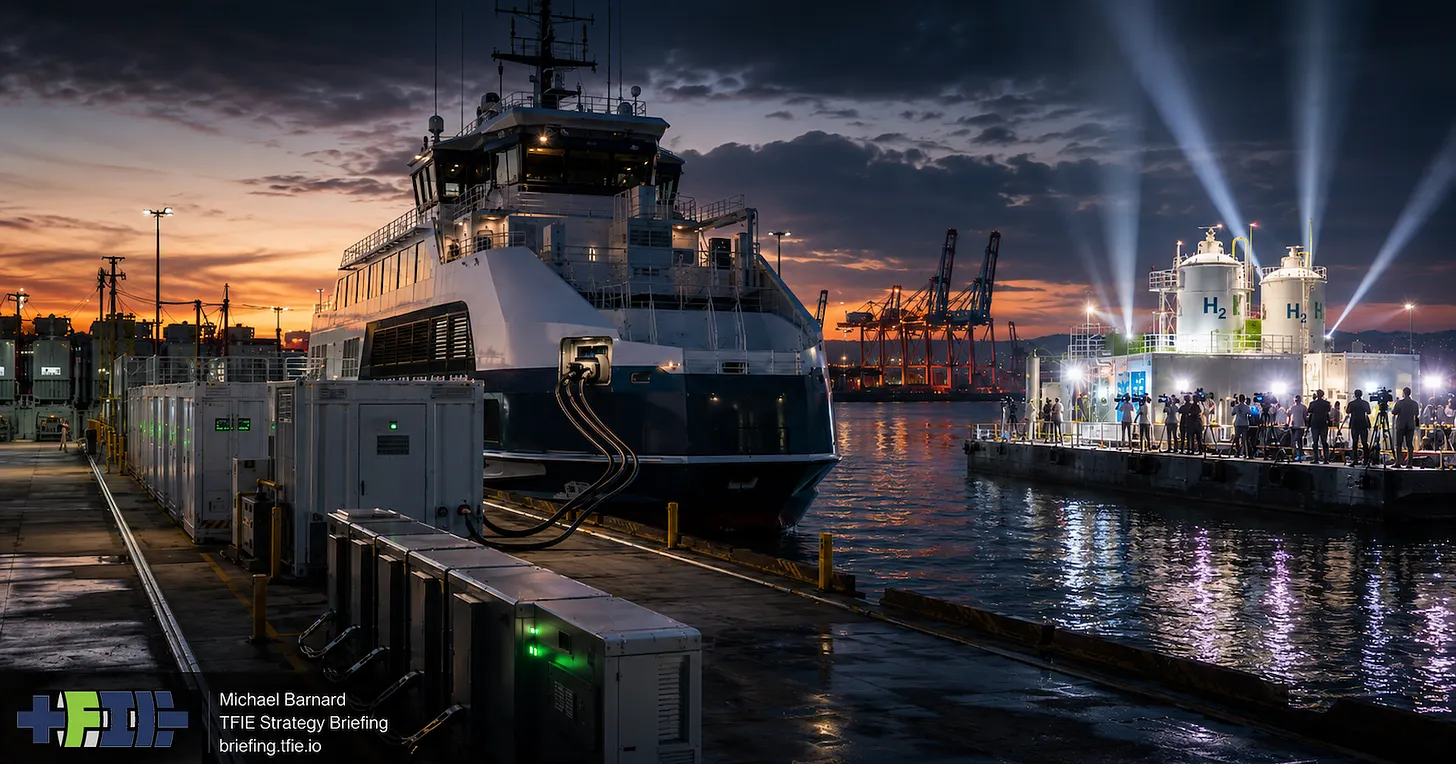
GeoPura recently deployed a hydrogen power unit on a floating platform at the Port of Tilbury on the Thames to charge a battery-electric commercial vessel. The system utilized five Ballard fuel cells to deliver 300 kilowatts of power. While the demonstration successfully proved that hydrogen can be converted into electricity and used to charge ship batteries, observers have questioned the practical necessity of hydrogen in this particular application.
Ports face genuine infrastructure challenges when supplying temporary high-power loads to vessels. A ship’s berth may require several hundred kilowatts to several megawatts of power for short periods, while local grid connections cannot support such instantaneous demand. Upgrading distribution infrastructure takes considerable time and presents logistical difficulties at industrial sites. This constraint parallels battery-storage requirements, where stationary batteries could be charged gradually between ship arrivals and then discharged rapidly when vessels dock.
The hydrogen conversion process involves additional inefficiencies compared to direct battery solutions. According to GeoPura’s own efficiency data, approximately 3.1 megawatt-hours of input electricity produces about 1 megawatt-hour of usable electricity after conversion through fuel cells. This energy loss occurs because renewable electricity must be converted to hydrogen, stored, transported, and then reconverted through fuel cells before powering the ship’s battery.
Hydrogen equipment may prove more suitable for applications where grid electricity is genuinely unavailable, such as temporary construction sites, remote facilities, or events. However, ports represent a harder case for hydrogen justification when the primary need is high-power battery charging. A scalable maritime charging system requires repeated customers, high utilization rates, economical tariffs, and infrastructure that gains value as adoption increases.
The distinction between technological demonstrations and commercially viable systems remains critical. While the Tilbury event generated significant media attention and photographic interest, commercial significance will depend on operators demonstrating vessel utilization numbers, megawatt-hour supply volumes, delivered electricity costs, and adoption at additional ports. The maritime energy transition will likely progress through routine operations rather than successive technological firsts, with infrastructure becoming less visually distinctive as electrification succeeds.
Article Attribution | Read More at Article Source
Article summary produced by Claude AI