

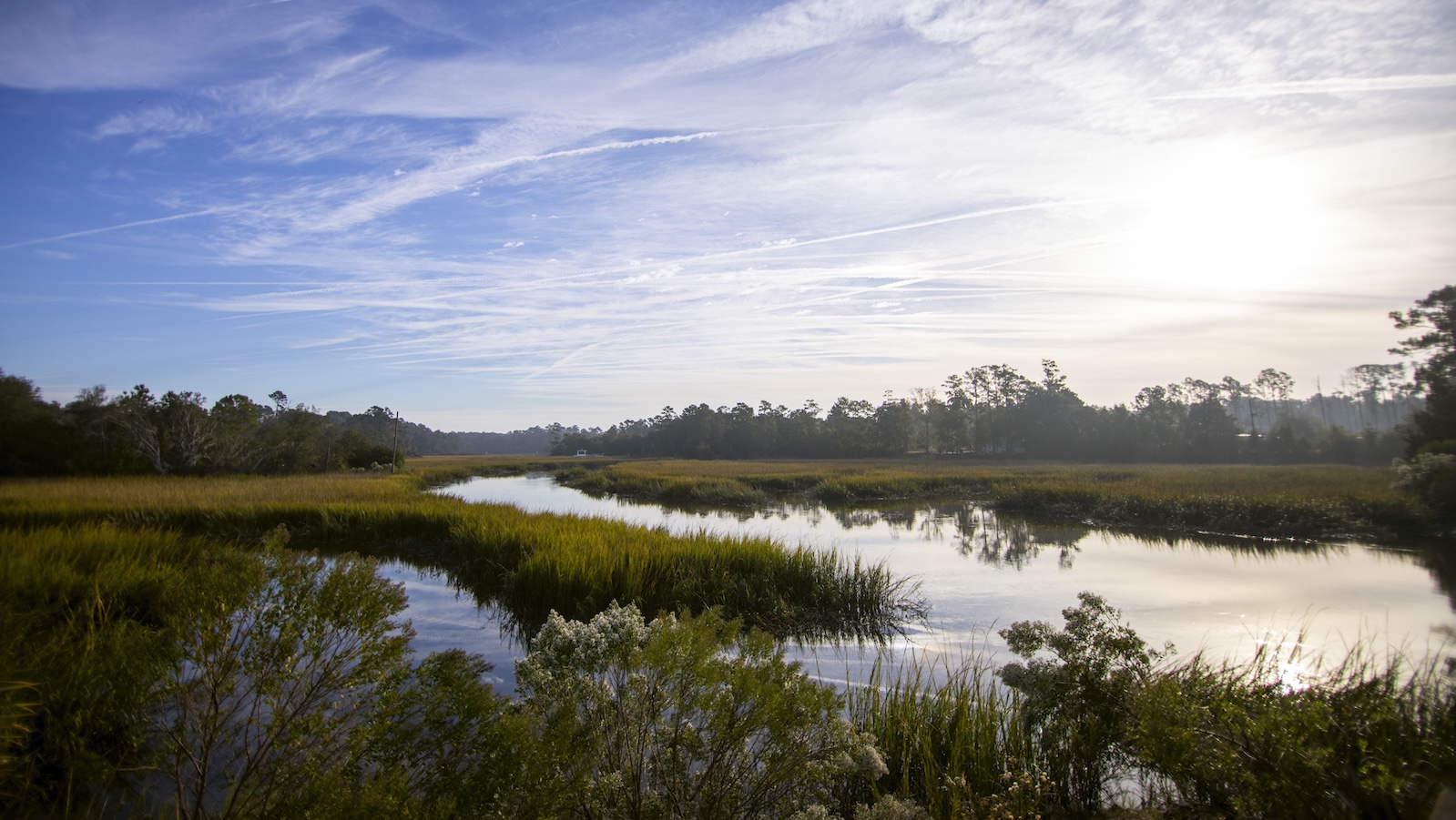
Coastal communities in Georgia are implementing new approaches to address erosion and marsh degradation along the state’s shoreline. In areas like Midway, located south of Savannah, officials are shifting away from traditional hard infrastructure solutions such as concrete barriers and are instead focusing on restoring natural marsh grasses whose root systems help stabilize eroding banks. This living shoreline approach aims to blend restoration efforts seamlessly with existing natural landscapes.
Georgia contains more than one-third of the connected marsh habitat found along the Southeastern U.S. coast, comprising hundreds of thousands of acres that serve as critical buffers against storms and are broadly protected under state law. However, rising sea levels driven by climate change present a growing challenge to these ecosystems. Scientists project that sea levels along Georgia’s coast will rise between one and two meters over the next 75 years, requiring marshes to migrate inland to survive.
While salt marshes have natural adaptability that allows them to persist in twice-daily tidal conditions, their migration depends on available space. When marshes encounter developed areas such as roads or buildings, they cannot establish new growth, leaving adjacent infrastructure vulnerable to flooding and erosion. To address this challenge, a coalition of conservation groups, scientists, government agencies, and coastal communities has developed an action plan identifying more than 56,000 acres of currently developable Georgia land where marshes are projected to migrate.
The South Atlantic Salt Marsh Initiative, a multi-state effort spearheaded in Georgia by the Georgia Conservancy, presents this identification as a roadmap rather than binding policy or land seizure. The plan aims to encourage informed decision-making among landowners and public officials regarding long-term land use, prompting consideration of whether development should extend to the water’s edge or whether space should be preserved for natural marsh migration. This approach seeks to balance immediate development interests with the long-term resilience of Georgia’s coastal ecosystems.
Article Attribution | Read More at Article Source
Article summary produced by Claude AI