

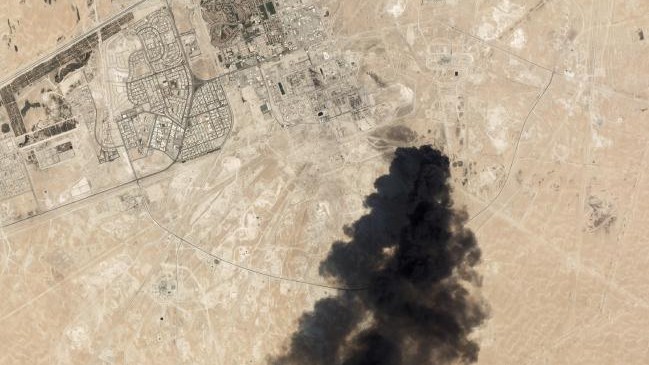
Saudi Arabia’s Abqaiq oil-processing complex, described as the world’s largest facility and the heart of the Kingdom’s export system, has become the target of what analysts consider one of the most significant energy developments of 2026. The facility processes crude from major fields and handles more than seven million barrels per day, making it strategically critical to global energy security. While initial oil price reactions have been restrained and Saudi officials have remained largely silent on the incident’s scope, satellite imagery indicates that damage may have extended beyond peripheral storage infrastructure to processing equipment itself, marking similarities to previous Iranian attacks.
The absence of detailed official assessments from Saudi Aramco or the Saudi Ministry of Energy regarding operational status, affected processing units, and repair timelines has fueled market uncertainty. Damage to processing infrastructure differs fundamentally from storage tank damage, as processing systems operate as integrated chains where even minor physical damage can trigger extensive shutdowns and complicate inspections and safety certifications. The lack of transparency contrasts with expected protocols for incidents at the world’s most strategically important energy facility.
Abqaiq is no longer facing pressure in isolation. Saudi Arabia’s broader export system, including the East-West Pipeline, Yanbu export terminal, and related infrastructure, has experienced multiple simultaneous pressures from various actors. The Kingdom’s historical advantage has rested on redundancy—the ability to reroute supplies and maintain spare processing capacity during disruptions. Analysts contend that recent attacks appear coordinated to systematically undermine confidence in Saudi export reliability by applying simultaneous pressure across critical infrastructure nodes rather than attempting to remove massive production volumes instantly.
Markets may be underestimating the delay between physical damage and commercial consequences, with disruptions likely to appear first in cargo nominations, tanker schedules, and refinery operations before affecting benchmark prices. The incident underscores growing recognition that processing and refining infrastructure, rather than upstream production alone, increasingly represents the energy system’s bottleneck. Rather than targeting production volumes directly, the apparent strategy involves repeatedly forcing inspections, delaying repairs, increasing costs, and raising uncertainty over export reliability—creating outsized market impacts without catastrophic volume losses.
For Saudi Arabia, the fundamental challenge has shifted from operational to strategic. While production capacity remains intact, protecting an integrated export system stretching across producing fields, pipelines, terminals, and contested maritime chokepoints grows progressively harder. The core question facing markets is no longer whether Saudi Arabia can produce sufficient oil, but whether it can guarantee uninterrupted exports. This uncertainty about export reliability, rather than actual production losses, may ultimately prove the most significant consequence of recent attacks.
Article Attribution | Read More at Article Source
Article summary produced by Claude AI