

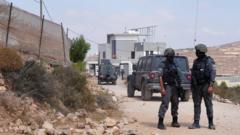
Activist groups attempted to deliver supplies to Palestinians in Qusra whose homes have been surrounded by Israeli settlers since the beginning of the week. The residents of two houses belonging to the Abu Ridi and Hassan families had their power and water services cut off during the siege. According to accounts from the residents themselves, Israeli military personnel blocked activists from directly handing over water and food provisions, requiring the supplies to be left outside the homes instead. The Israeli Defense Forces disputed this characterization, stating that activists were not prevented from transferring aid to the Palestinian residences.
During the same day, settlers erected a temporary tent structure near the area, which was subsequently dismantled by Israeli military forces. The IDF designated Qusra as a restricted military zone, citing this designation as the reason civilian activists were unable to enter, though the military maintained that aid transfer was permitted. In a parallel development, Israeli military personnel dispersed settlers from the location on the previous day, during which approximately a dozen Palestinian households were ordered to evacuate their properties. The mayor of Qusra reported that Israeli forces subsequently occupied some of the vacated Palestinian structures as military barracks.
The initial blockade commenced when settlers obstructed access roads to Palestinian properties and cut utilities. Subsequent efforts to remove settlers on the day prior to the aid delivery escalated into confrontations involving larger numbers of settlers, during which security forces deployed tear gas and stun grenades. The military acknowledged that soldiers who engaged in prayer with settlers at the site would face disciplinary action.
Settler activity in the West Bank has emerged as an increasingly challenging issue for Israeli security forces. According to United Nations documentation, approximately 3,800 Palestinians have been displaced due to settler actions, property demolitions, and evictions in 2026 alone, with nearly half of the displaced individuals being children. Since the start of 2023, over 127 Palestinian communities experienced displacement, with 47 experiencing total displacement affecting more than 6,390 individuals.
Article Attribution | Read More at Article Source
Article summary produced by Claude AI