

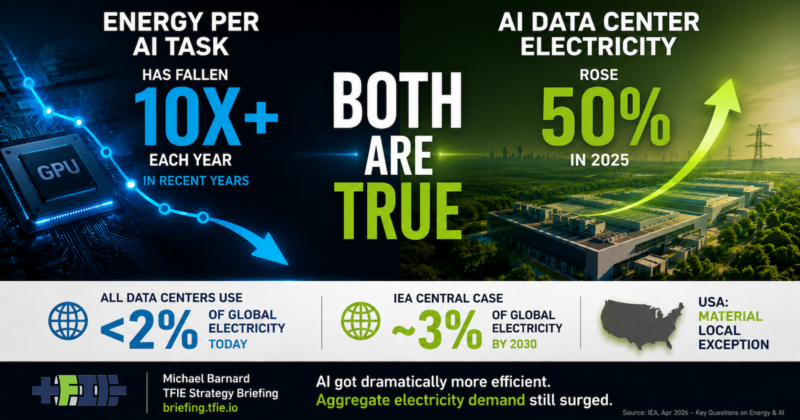
Artificial intelligence has fundamentally altered electricity demand patterns in the data-center sector, with utilities in several US regions now confronting load levels substantial enough to influence generation planning and infrastructure requirements. The scale of growth marks a departure from the relatively flat demand trajectory observed during much of the 2000s and 2010s, when efficiency improvements and consolidation offset increased digital activity.
Historical precedent suggests caution when projecting current trends forward. In 2006, US data centers consumed approximately 60 billion kilowatt-hours, representing 1.5% of national consumption, with predictions of near-doubling within five years. By 2014, consumption had reached only 70 billion kilowatt-hours, or 1.8% of national use, as servers became more efficient, virtualization improved utilization rates, and workloads migrated to hyperscale facilities. Similar patterns emerged with cloud computing and cryptocurrency, where initial concerns about unbounded growth were tempered by consolidation and optimization.
AI’s distinguishing characteristic lies in growth rates that have outpaced efficiency improvements. The International Energy Agency projects global data-center electricity consumption rising from approximately 415 terawatt-hours in 2024 to roughly 945 terawatt-hours by 2030, representing an increase from 1.5% to nearly 3% of world electricity consumption. While substantial, this trajectory differs markedly from narratives suggesting AI will become the dominant global electricity problem.
The United States presents a markedly different situation due to geographic concentration. The nation accounts for roughly 45% of global data-center electricity consumption, with capacity clustered in limited regional areas. Berkeley Lab modeling estimates US data-center consumption reaching approximately 11.8% of national electricity by 2030, constituting a major shift in the electricity system. Regional impacts can exceed national percentages, as clusters of hyperscale facilities create concentrated demands on specific substations and transmission corridors with lengthy development timelines.
Forecasting complexity extends beyond load estimation. Computing history demonstrates that five-year projections must account for multiple generations of hardware evolution, architectural changes, efficiency innovations in compression and caching, cooling system improvements, and shifts from expansion phases toward financial discipline. Infrastructure constraints including financing, chip availability, transformer supplies and interconnection queues will influence actual capacity deployment. Efficiency gains, while not reducing total consumption due to rebound effects, substantially affect projection accuracy when demand and energy intensity both remain uncertain. Appropriate planning requires utilities in major data-center regions to prepare for demanding scenarios while maintaining flexibility regarding 2030 endpoints, avoiding treatment of projections as settled observations.
Article Attribution | Read More at Article Source
Article summary produced by Claude AI