

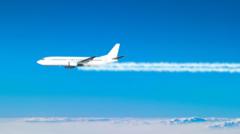
A collaborative project called Operation Blue Skies will investigate the use of artificial intelligence to help aircraft avoid contrails over the North Atlantic. The initiative, funded at £5m with contributions from Google, the UK government, the Met Office, National Air Traffic Services (NATS), and academic institutions, aims to determine whether predictive technology can reduce aviation’s contribution to climate warming.
Contrails form when hot aircraft engine exhaust meets cold air at high altitudes, creating ice crystals. While many dissipate quickly, those that persist in cold and humid conditions can trap atmospheric heat, contributing significantly to aviation’s climate impact. Scientists estimate contrail warming accounts for roughly one-third of aviation-related climate warming, though uncertainty remains around the precise figure.
The trial will focus on the Shanwick Oceanic airspace in the eastern North Atlantic, which represents approximately 5% of global contrail warming. Google will analyze satellite imagery and flight data to identify atmospheric conditions where contrails form, then share this information with air traffic controllers. Rather than drastically altering routes, pilots will typically adjust aircraft altitude by approximately 2,000 feet—a maneuver already performed routinely to avoid turbulence and adverse weather.
Testing is scheduled for selected evenings and nights during the winters of 2026-27 and 2027-28, when air traffic volume is reduced. Around 10,000 flights are expected to pass through the airspace during trial periods, though only a fraction will require altitude adjustments specifically to avoid contrails. Concerns about additional fuel consumption from altitude changes were addressed by previous trials suggesting minimal fuel penalties compared to the climate benefits of preventing contrails.
Findings from Operation Blue Skies are expected to be published in academic literature for scientific review. The project represents a test of technology-based solutions to reduce aviation’s environmental footprint as airline traffic continues to grow.
Article Attribution | Read More at Article Source
Article summary produced by Claude AI