

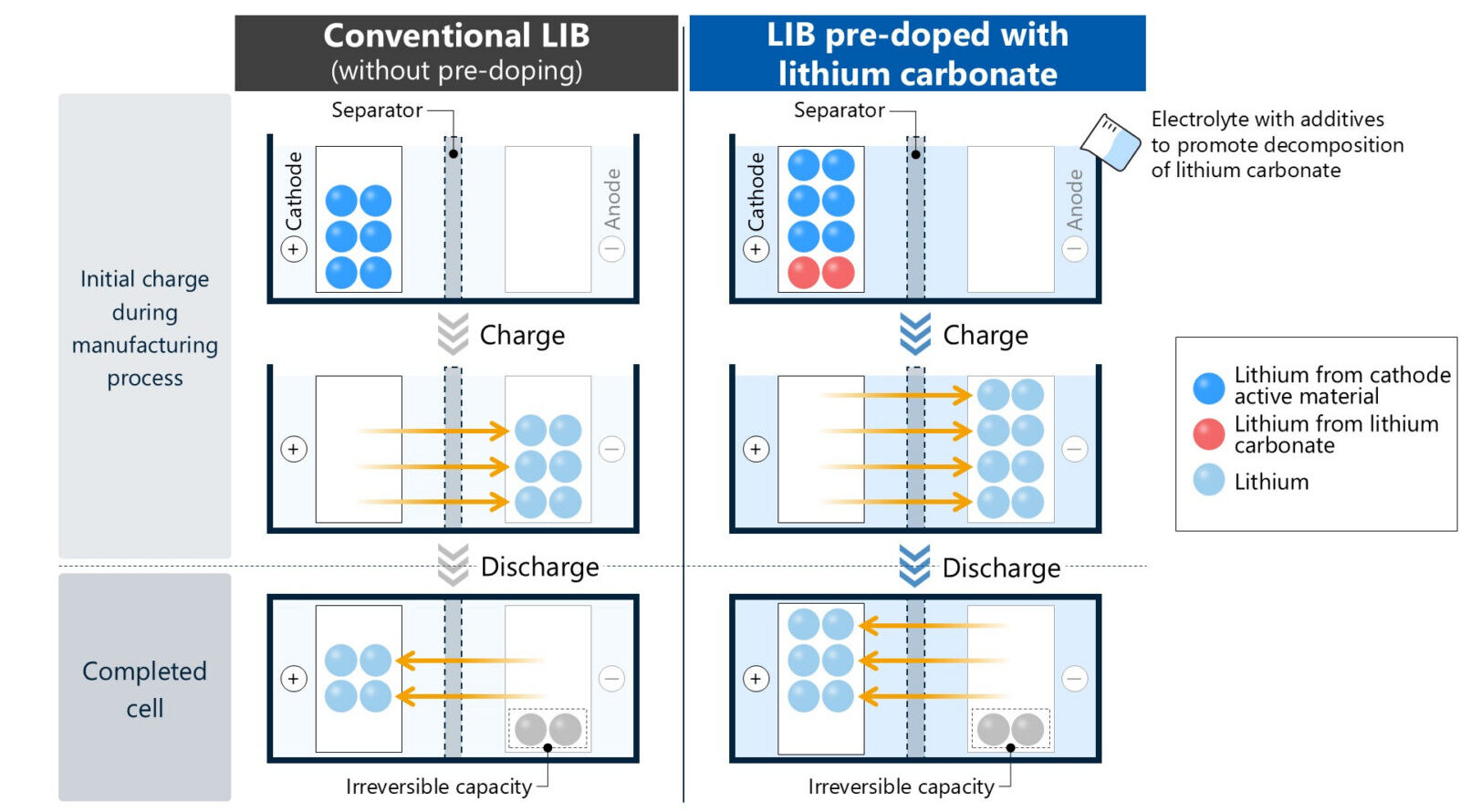
Asahi Kasei Corporation announced the development of a novel pre-doping technology designed to improve the performance of high-voltage lithium-ion batteries that incorporate silicon-based anodes. The technology leverages lithium carbonate as an additional lithium source operating at lower voltages, addressing a key challenge that has limited the adoption of silicon-rich battery configurations. The company plans to engage with customers globally to evaluate practical implementations through proof-of-concept studies.
The growing demand for energy-dense batteries stems from increased adoption of electric vehicles and humanoid robots, spurring manufacturers to explore ways to boost battery performance. Industry development has centered on partially substituting silicon-based materials for graphite in anodes and raising the operating voltage of cathode systems. Silicon-based anodes, however, experience significant irreversible capacity loss during initial charging cycles, which constrains overall battery lifespan and energy density. Conventional compensation methods require additional cathode active material, raising production costs and material consumption.
Asahi Kasei selected lithium carbonate as the basis for its innovation due to its relatively low cost and established history in battery applications. The primary obstacle was that lithium carbonate’s decomposition voltage typically exceeds the standard operating range of conventional lithium-ion batteries. The company’s solution incorporates specialized electrolyte additives that facilitate lithium carbonate decomposition at normal battery voltages, enabling the material to function as a sacrificial lithium source during initial charging. Laboratory testing of an NMC cell configuration with a 90% graphite and 10% silicon monoxide anode demonstrated a 10% improvement in energy density alongside enhanced cycle life and cost efficiency per watt-hour.
The technology requires no significant modifications to existing manufacturing infrastructure and demonstrates broad applicability across various cathode and anode material combinations. Asahi Kasei intends to pursue a licensing strategy with flexible collaboration frameworks adapted to individual customer requirements. This initiative aligns with the company’s Technology-value Business Creation program, which seeks to monetize proprietary assets including patents, algorithms, and technical knowledge. The company has set targets to execute at least 10 new licensing agreements between fiscal 2025 and 2027, generating cumulative profits exceeding ¥10 billion by approximately 2030.
Article Attribution | Read More at Article Source
Article summary produced by Claude AI