

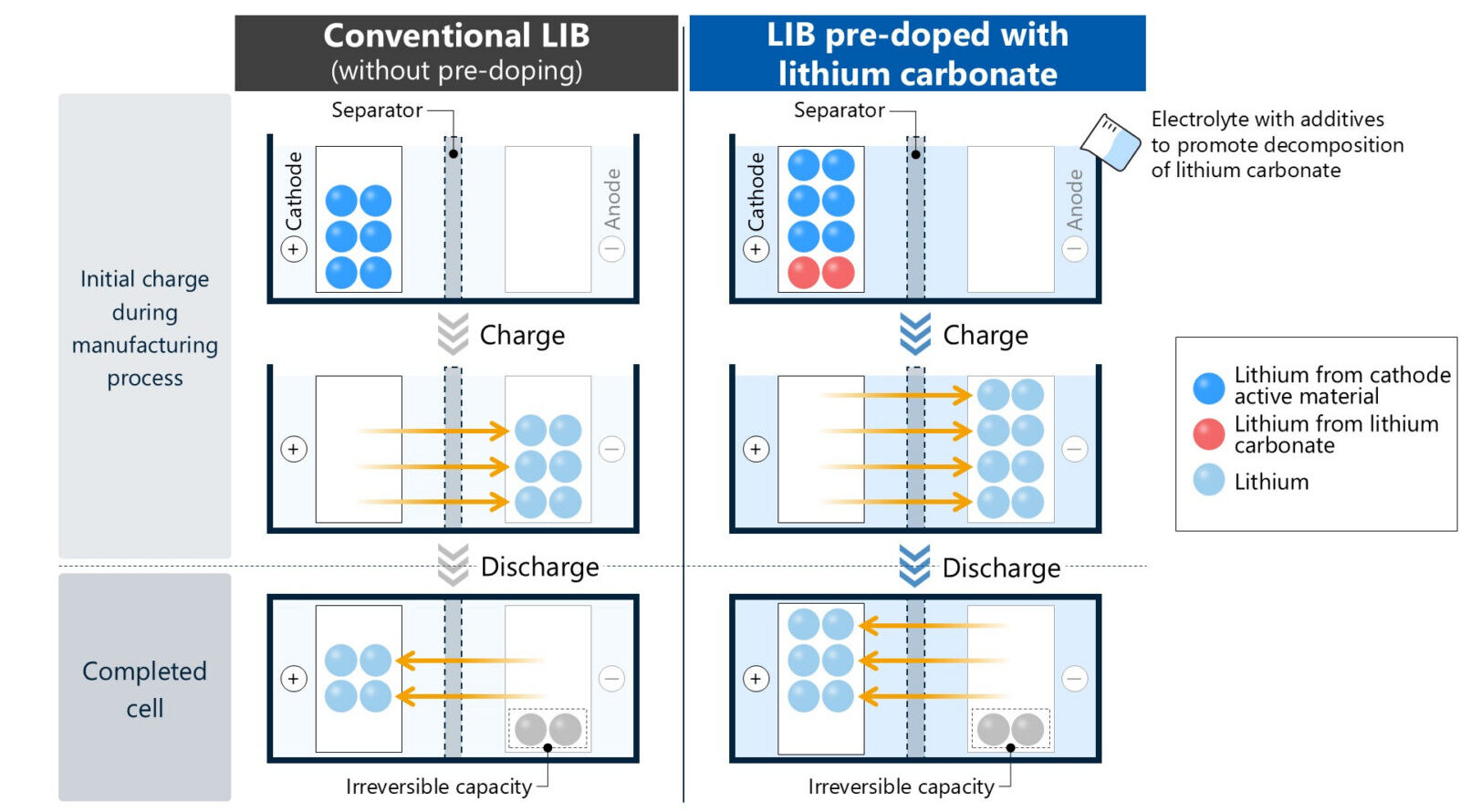
Asahi Kasei has unveiled a novel pre-doping technology designed to enhance the performance of high-voltage lithium-ion batteries equipped with silicon-based anodes. The innovation leverages lithium carbonate as an additional lithium source, which operates at lower voltages and mitigates the permanent capacity loss that typically occurs during the initial charge-discharge cycle of silicon-rich battery cells.
The development addresses growing demands from the electric vehicle and humanoid robotics industries for batteries with higher energy densities. Current approaches to meeting these requirements involve partially substituting graphite with silicon-based materials in the anode while simultaneously increasing the operating voltage of cathode materials. However, silicon-based anodes face a significant challenge: they experience substantial and irreversible capacity loss during their first charge cycle, which diminishes battery lifespan and overall energy density. Compensating for this loss typically requires additional cathode active material, driving up manufacturing costs and material consumption.
Asahi Kasei’s approach focuses on lithium carbonate, selected for its relatively low cost and established history as a battery material. The company’s researchers developed special electrolyte additives that enable lithium carbonate decomposition at the typical operating voltages of conventional lithium-ion batteries. Previously, this decomposition occurred at voltages far above standard operating ranges, making the material unsuitable for pre-doping applications. By introducing lithium carbonate as a sacrificial lithium source to the cathode, the technology allows decomposition during initial charging to supply lithium ions while maintaining cost efficiency.
Internal testing demonstrated a 10% increase in energy density using an NMC cell with an anode containing 90% graphite and 10% silicon monoxide. The technology offers additional benefits including improved cycle life, lower cost per watt-hour, and compatibility with existing battery manufacturing processes without requiring substantial modifications.
Asahi Kasei intends to commercialize the technology through licensing agreements with partners worldwide, supported by proof-of-concept evaluations. This initiative aligns with the company’s Technology-value Business Creation program, which seeks to monetize intangible assets including patents and proprietary knowledge. The company targets at least 10 new license agreements during fiscal 2025–2027, anticipating cumulative profit contributions of ¥10 billion or more by around 2030.
Article Attribution | Read More at Article Source
Article summary produced by Claude AI