

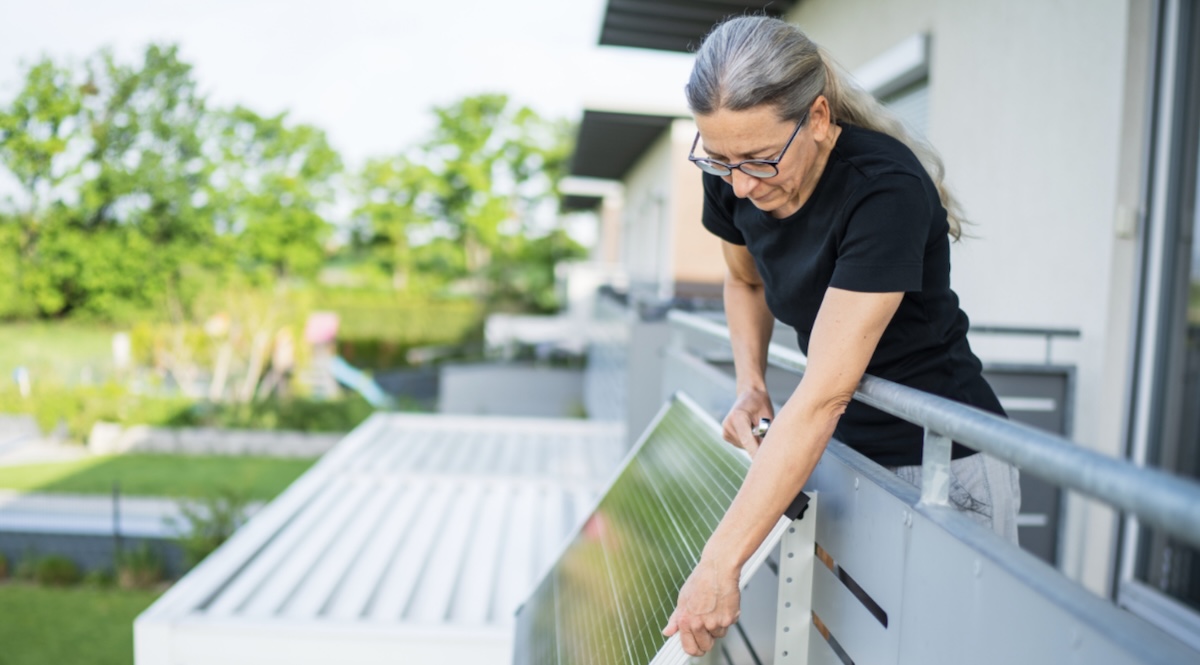
The California Legislature has passed Senate Bill 868, legislation designed to streamline the installation of small, portable solar panel systems commonly referred to as balcony solar. The measure, authored by Senator Scott Wiener of San Francisco and sponsored by the Environmental Working Group and Abundance Network, aims to remove administrative obstacles that have prevented widespread adoption of these systems across residential properties.
Currently, prospective users must obtain interconnection agreements from utility companies before installing balcony solar systems, a process that involves considerable time and expense. SB 868 would eliminate this requirement while maintaining strict safety standards. Systems would need to be certified by Underwriters Laboratories or an equivalent testing facility and would automatically shut off within seconds during power outages to prevent electrical hazards. The legislation caps system size at 1,200 watts, sufficient to power typical household appliances including refrigerators, lighting, Wi-Fi equipment, and air conditioning units.
Proponents assert that balcony solar offers significant economic benefits for California residents facing rising energy costs. A single 400-watt system could cover approximately 14% of an average apartment’s electricity consumption and generate roughly $250 in annual savings. Current retail pricing starts around $500, though supporters anticipate costs will decline as adoption expands. The technology has gained substantial traction in Europe, with over 4 million systems installed in Germany alone.
The Assembly included a sunset provision in the bill that would terminate the interconnection exemption on January 1, 2030, language requested by utility companies. This provision allows four years for market development before the exemption would expire unless the Legislature votes to extend it. The bill now proceeds to Governor Gavin Newsom for his consideration, with action required within 30 days. California becomes the second state with such legislation awaiting gubernatorial signature, following New York, and joins nine other states that have already enacted similar laws.
Article Attribution | Read More at Article Source
Article summary produced by Claude AI