

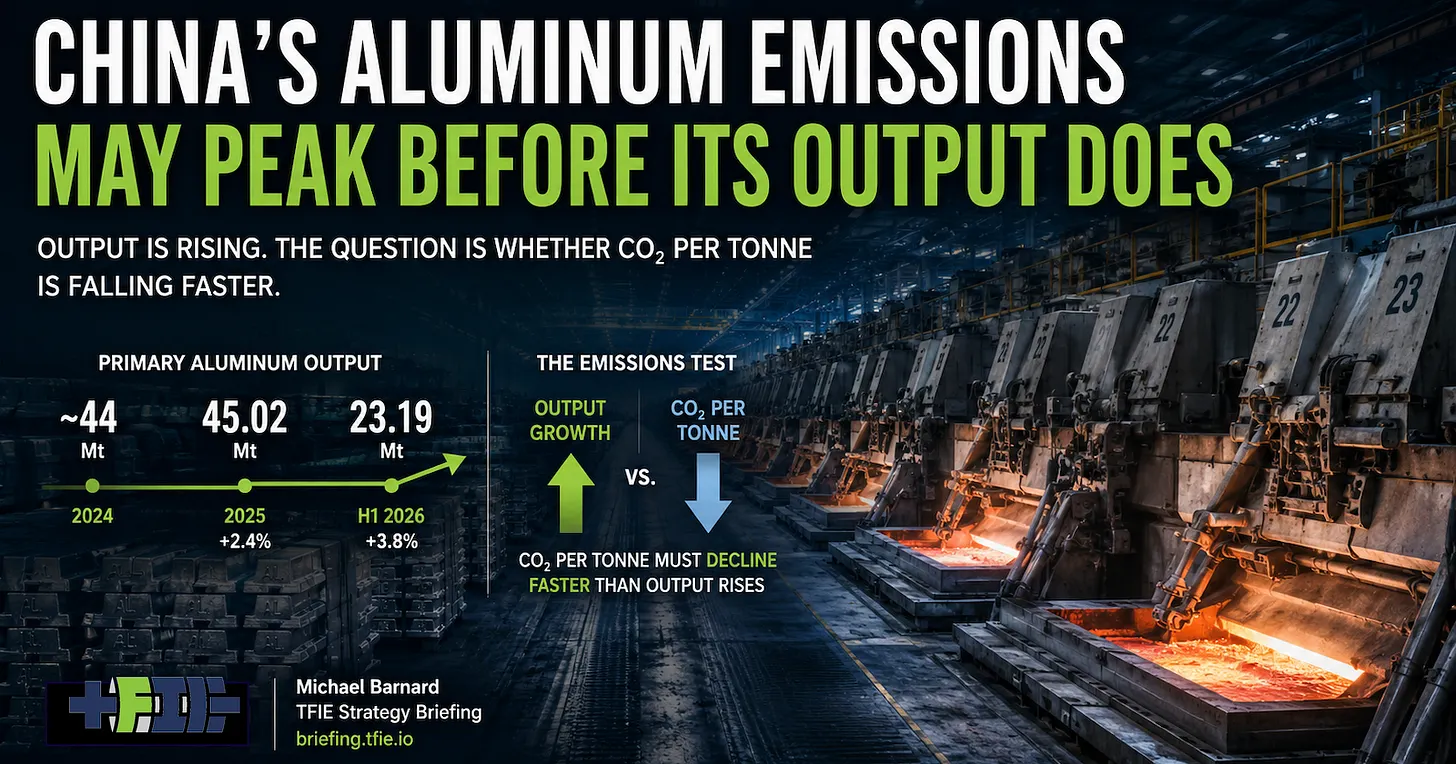
China’s primary aluminum production reached 45.02 million tonnes in 2025, marking a 2.4% increase from the previous year, with an additional 23.19 million tonnes produced during the first half of 2026, up 3.8% year over year. These production gains have challenged earlier assumptions that the sector’s output would remain constrained at nominal capacity levels.
The expanded production does not necessarily invalidate projections that emissions may have peaked, since aluminum smelting’s extreme electricity intensity means that carbon dioxide levels and metal tonnage do not move in lockstep. If emissions intensity declines faster than production increases, total sectoral emissions could flatten and subsequently decline despite rising output volumes. This scenario would represent a more significant industrial decarbonization achievement than production-driven peak theories, as it would demonstrate that output growth and emissions reductions can occur simultaneously.
Several factors support the possibility of such decoupling. China’s Ministry of Industry and Information Technology reported that clean energy accounted for approximately 25% of electrolytic aluminum energy consumption in 2024, with average electricity consumption declining roughly 2% since 2020. Government policies for 2025 through 2027 target increasing the clean energy share above 30% and mandate continued upgrades or closure of inefficient capacity. Northern and northwestern regions, traditionally viewed as coal-dependent, have become major centers for wind and solar development, shifting focus from geographic labeling to the actual carbon intensity of electricity delivered to individual facilities.
Recycled aluminum represents another substantial opportunity. China produced roughly 10.5 million tonnes of secondary aluminum in 2024 and aims to reach more than 15 million tonnes by 2027. Expanded recycling could supply an increasing share of market demand while primary production plateaus, as decades of aluminum investment in vehicles, buildings and infrastructure generate growing scrap supplies. Combined with grid decarbonization and electrolysis process improvements, recycling can contribute to absolute emissions reductions without requiring primary production collapse.
China’s national emissions trading system, which included aluminum starting in 2025, covers direct emissions and perfluorocarbon production but excludes purchased electricity and heat—a significant limitation for the sector. Grid decarbonization and clean-power procurement therefore remain more consequential than the ETS framework itself. The coming years will reveal whether production growth can continue while cleaner electricity sources, efficiency gains and circular economy practices combine to reduce absolute emissions levels.
Article Attribution | Read More at Article Source
Article summary produced by Claude AI