

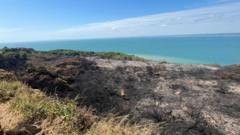
Emergency crews addressed a secondary fire event at Headon Warren on the Isle of Wight, where peat deposits were burning beneath the surface. The blaze occurred about midday on Tuesday, several days after the initial wildfire concluded. According to Hampshire & Isle of Wight Fire and Rescue Service, underground peat can sustain smoldering conditions for extended periods when heat becomes trapped within the soil.
The original fire began on 23 July and consumed approximately nine hectares of heathland across the coastal site. Firefighting operations proved challenging given the area’s remote location, steep topography, and proximity to cliff edges. At the peak of the initial response, 80 firefighters mobilized to combat the flames, with crews from mainland England transported to support Isle of Wight personnel. Aerial support was also deployed, with a helicopter dropping seawater onto affected areas.
Investigations at the site identified remains of a campfire as the ignition source. The National Trust, which oversees the 30-hectare property as part of a conservation partnership with Warren Farm and Natural England, noted that ecological recovery will require years. The organization warned that the fire likely resulted in significant mortality among nesting birds and various other wildlife species, including reptiles, small mammals, and amphibians that had previously flourished in the relatively undisturbed landscape.
Headon Warren encompasses the Isle of Wight’s largest maritime heathland and rare limestone grassland habitats. Prior to the fire, the area’s isolated character limited human and canine visitor traffic, creating conditions favorable for wildlife populations. Authorities have since reopened footpaths but requested visitors avoid burned zones to facilitate site recovery and protect remaining wildlife resources.
Article Attribution | Read More at Article Source
Article summary produced by Claude AI