

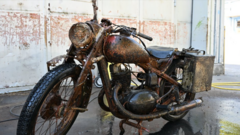
The bodies of two German soldiers from World War Two have been recovered from the Danube River in Budapest following an intense drought that brought water levels to record lows. The discovery was made on August 2 when a passerby reported a motorcycle protruding from rocks on the riverbank in downtown Budapest. Alongside the remains, investigators found identification tags belonging to one Wehrmacht soldier and one Waffen-SS member, a largely intact German army motorcycle, a wedding ring, and a Kuban shield combat badge.
The remarkable preservation of artifacts including the identification tags and motorcycle is attributed to a mixture of harbor sludge and oil on the river bed. The motorcycle is believed to be a DKW NZ 350-1 model, produced specifically for wartime use beginning in 1944. The discovery also included anti-tank mines, which prompted temporary closure of the riverbank while bomb disposal units were deployed.
The German War Graves Commission, a non-profit organization that searches for and recovers war dead on behalf of the German government, has begun an investigation to identify the two soldiers. During World War Two, German military identification tags were split upon a soldier’s death, with one half remaining with the body and the other sent to army authorities to notify families. According to the commission, the families of these two soldiers “waited in vain” for official notification of their deaths.
The identification process will require multiple steps beyond simply matching names on the tags to determine if the artifacts actually belonged to the recovered soldiers. Bone analysis will be a key method in establishing identities, and the commission stated that determining who the soldiers were would take considerable time. Families searching for missing relatives from the war can consult the commission’s database. Once identified, the soldiers are scheduled to be buried at the German war cemetery in Budaörs, outside Budapest.
The discovery has generated significant interest in World War Two-related online communities, with observers noting that while the low water levels are problematic, they offer bereaved families an opportunity to finally learn the fates of missing relatives. Budapest was the site of intense fighting between Soviet and German forces late in the war, and other World War Two remnants have recently surfaced in the Danube, including a broken hull near Prahovo in Serbia.
Article Attribution | Read More at Article Source
Article summary produced by Claude AI