

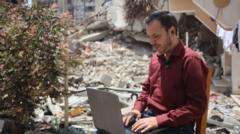
Gaza’s technology sector is experiencing a resurgence as thousands of young Palestinians turn to remote digital work to earn income in a territory facing an unemployment rate exceeding 80%. This shift represents a significant change from the pre-conflict era, when the sector already served as a critical outlet for graduates seeking to overcome border restrictions imposed by the Israeli and Egyptian blockade.
Several tech workers have emerged as examples of this trend. Walaa Volidis, a 24-year-old software engineer, lost her job, university enrollment, and family members when the conflict began but has since secured a position with a Dubai-based firm while supporting her displaced parents and siblings from a tent in central Gaza. Tarik Zaeem, a former chief technology officer, has restarted his career as a freelance programmer developing applications for clients in Saudi Arabia and elsewhere. Mahran Bayed, who lost his home, office, and equipment, now creates mobile apps and websites for international clients while living in a tent near destroyed infrastructure.
Humanitarian organizations including Mercy Corps have established co-working spaces equipped with generators and solar panels to provide stable internet connections and power in a territory where the power system has largely collapsed and approximately 75% of telecommunications networks have been damaged. These facilities have become essential infrastructure for workers seeking reliable working conditions. However, significant barriers persist, including severe cash shortages, banking system disruptions, and restrictions on digital payment platform access that force many workers to rely on currency brokers who charge substantial fees, sometimes reducing payments by half.
The Israeli defence authority Cogat classifies computer components as dual-use items and restricts their importation, limiting repair and replacement options for damaged equipment. Additionally, ongoing military operations continue to create hazardous conditions for workers, with at least 1,250 people killed since a ceasefire began, according to Gaza’s health ministry figures deemed reliable by the UN.
Despite these obstacles, tech workers emphasize their relative advantage compared to the broader population and view remote work as both an economic necessity and a source of purpose and connection to the global economy.
Article Attribution | Read More at Article Source
Article summary produced by Claude AI