

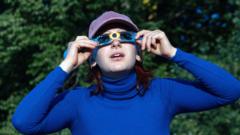
Medical professionals are advising the public to monitor their eyesight following Wednesday’s eclipse, as damage from improper viewing practices can result in several vision-related complications. Potential warning signs include blurred vision, the appearance of a central dark or blind spot in the visual field, and heightened sensitivity to light exposure.
Historical data from the previous total eclipse visible in the United Kingdom in 1999 documented approximately 70 individuals who sustained sight damage, with some having looked at the phenomenon for less than one minute without protective equipment. The risk originates from the retina’s vulnerability to damage when exposed to unshielded sunlight or eclipse viewing. During an eclipse, the sun appears dimmer than normal, which can suppress the natural protective reflex that typically causes people to look away from bright light sources. This combination creates conditions where individuals may stare at the eclipse longer than they would at the ordinary sun, while still receiving harmful exposure to bright light and ultraviolet radiation.
The resulting condition, termed solar retinopathy, damages the retinal cells responsible for clear central vision. Because the retina lacks pain receptors, individuals may not immediately perceive the injury as it occurs. Alexander Ionides, a consultant eye surgeon at Moorfields Eye Hospital in London, noted that symptoms typically begin appearing within several hours of exposure. These may manifest as a grey, yellow, or dark spot in the center of the visual field, visual distortions, eye pain, redness, grittiness, sudden vision changes, or increased light sensitivity.
Individuals concerned about potential eye damage are advised to seek prompt medical evaluation. Opticians and local eye casualty departments in the UK offer retinal scans capable of detecting solar retinopathy. Early reports suggest fewer people have contacted hospitals following Wednesday’s eclipse compared to the 1999 event, potentially indicating increased public awareness of the risks associated with direct eclipse observation without proper protection.
Article Attribution | Read More at Article Source
Article summary produced by Claude AI