

According to the latest Statistical Review of World Energy, European nations have significantly reduced their reliance on imported fossil fuels through accelerated renewable energy development. Following Russia’s invasion of Ukraine at the beginning of 2022, the European Union moved forward with scaled-up renewable energy capacity plans, resulting in substantial changes to the region’s electricity supply composition.
Wind and solar power sources accounted for 30% of electricity supply in 2025, compared to 19% in 2021. This expansion displaced traditional energy sources, with gas generation declining by 15% during the same period and coal generation falling by 38%. By 2025, wind and solar combined generated 852 terawatt-hours of electricity, exceeding the combined output of coal, gas, and oil sources, which produced 760 terawatt-hours.
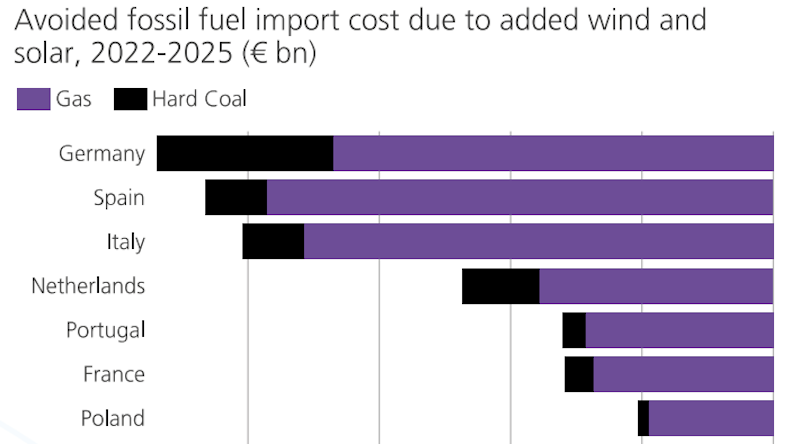
The rapid expansion of renewable energy capacity, supported by policy initiatives such as REPowerEU, has produced substantial economic benefits for the region. Analysis indicates that new wind and solar capacity deployed since Russia’s invasion of Ukraine prevented approximately €72 billion in fossil fuel import costs between 2022 and 2025. Germany, Spain, and Italy realized the largest savings from this shift. The majority of the financial benefits derived from avoided natural gas imports, reflecting the significant role that renewable sources played in reducing dependence on imported energy.
The deployment of wind and solar power has therefore provided a dual benefit to the European Union, simultaneously addressing energy security concerns related to reliance on hostile foreign sources while delivering measurable economic savings through reduced fossil fuel expenditures.
Article Attribution | Read More at Article Source
Article summary produced by Claude AI