

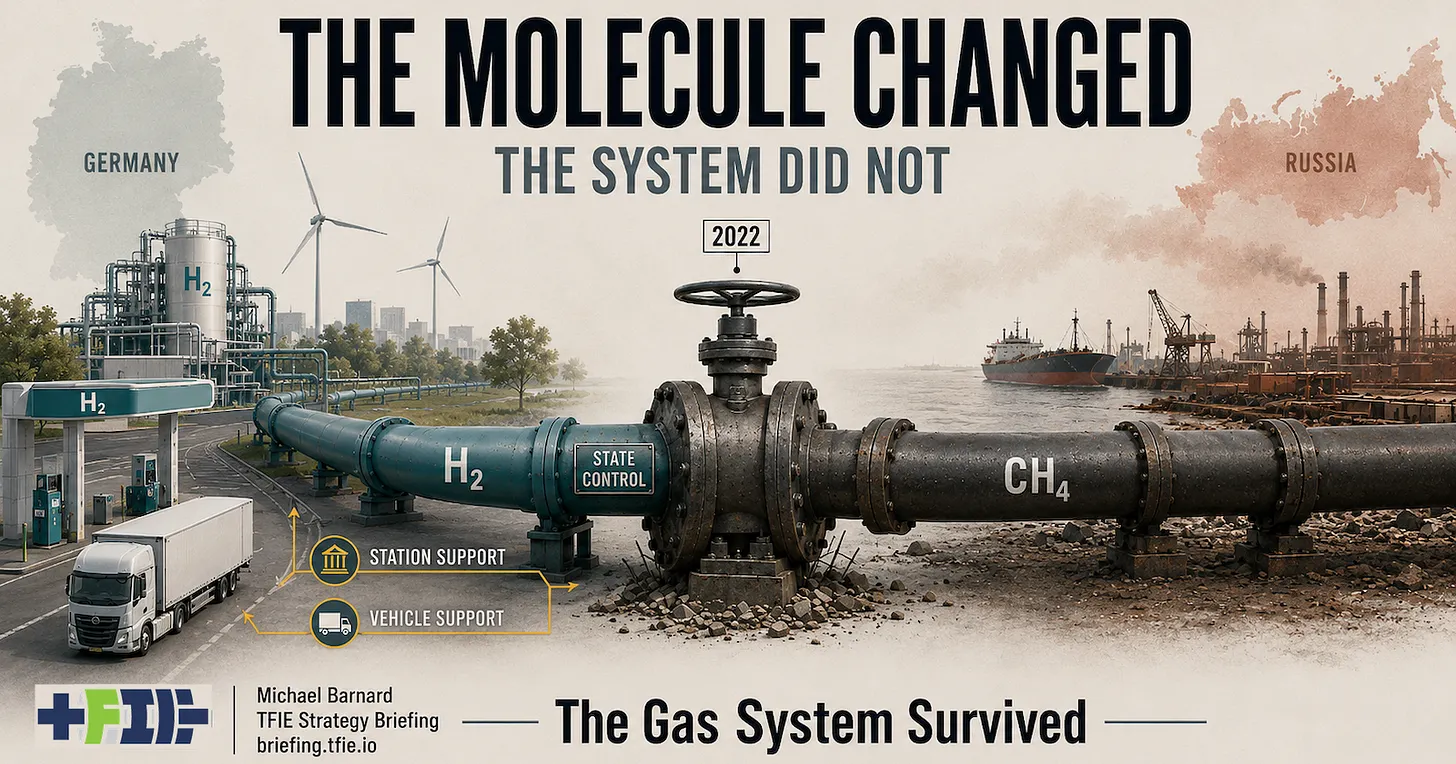
Germany has developed an extensive hydrogen strategy centered on converting existing natural gas infrastructure and supporting vehicle and refueling station deployment. A recent freight program received 526 applications requesting €455 million from a €220 million budget, with subsidies covering up to 50% of refueling station costs and up to 80% of the price premium for hydrogen trucks compared to conventional vehicles. However, analysis suggests these numbers indicate interest in subsidies rather than genuine commercial demand for hydrogen transportation.
The hydrogen push represents a continuation of Germany’s earlier reliance on Russian gas infrastructure and institutions. The former Gazprom Germania, placed under government trusteeship during the 2022 energy crisis and renamed Securing Energy for Europe (SEFE), was subsequently expanded through acquisition of pipeline operators GASCADE and NEL. These pipelines are now being converted for hydrogen use and included in Germany’s regulated asset base, which guarantees stable returns on infrastructure investments. Approximately 400 kilometers of natural gas pipelines have been converted for hydrogen, including portions originally built for Nord Stream 1 delivery.
Critics argue Germany’s approach inverts typical infrastructure development by building capacity before establishing credible supply and demand. The converted pipelines, sized for a full hydrogen economy rather than limited industrial feedstock needs, create pressure for ongoing subsidies to justify their existence and utilization. This pattern reflects what Germans term “institutioneller Filz”—an interconnected network of officials, institutions and commercial interests that reinforce each other’s positions and resist change.
The hydrogen refueling network has already struggled to meet utilization benchmarks globally. Stations dispensing limited fuel quantities cannot recover fixed costs through operations alone, despite grant support. Meanwhile, battery-electric truck technology has advanced significantly, with French and German economic advisers recommending governments prioritize depot charging and megawatt charging infrastructure instead. Germany allocates €1 billion over four years to heavy-truck charging but maintains asymmetric policy support favoring hydrogen.
Analysts contend the relevant metrics should include commercially produced low-carbon hydrogen volumes, contracted demand, pipeline throughput, fuel dispensing rates and repeat purchases after subsidies end—none of which currently exist at scale. While Germany requires low-carbon hydrogen for ammonia, chemicals and industrial feedstock, the current strategy appears designed to preserve every existing pipeline and gas-sector institution rather than meeting genuine hydrogen demand.
Article Attribution | Read More at Article Source
Article summary produced by Claude AI