

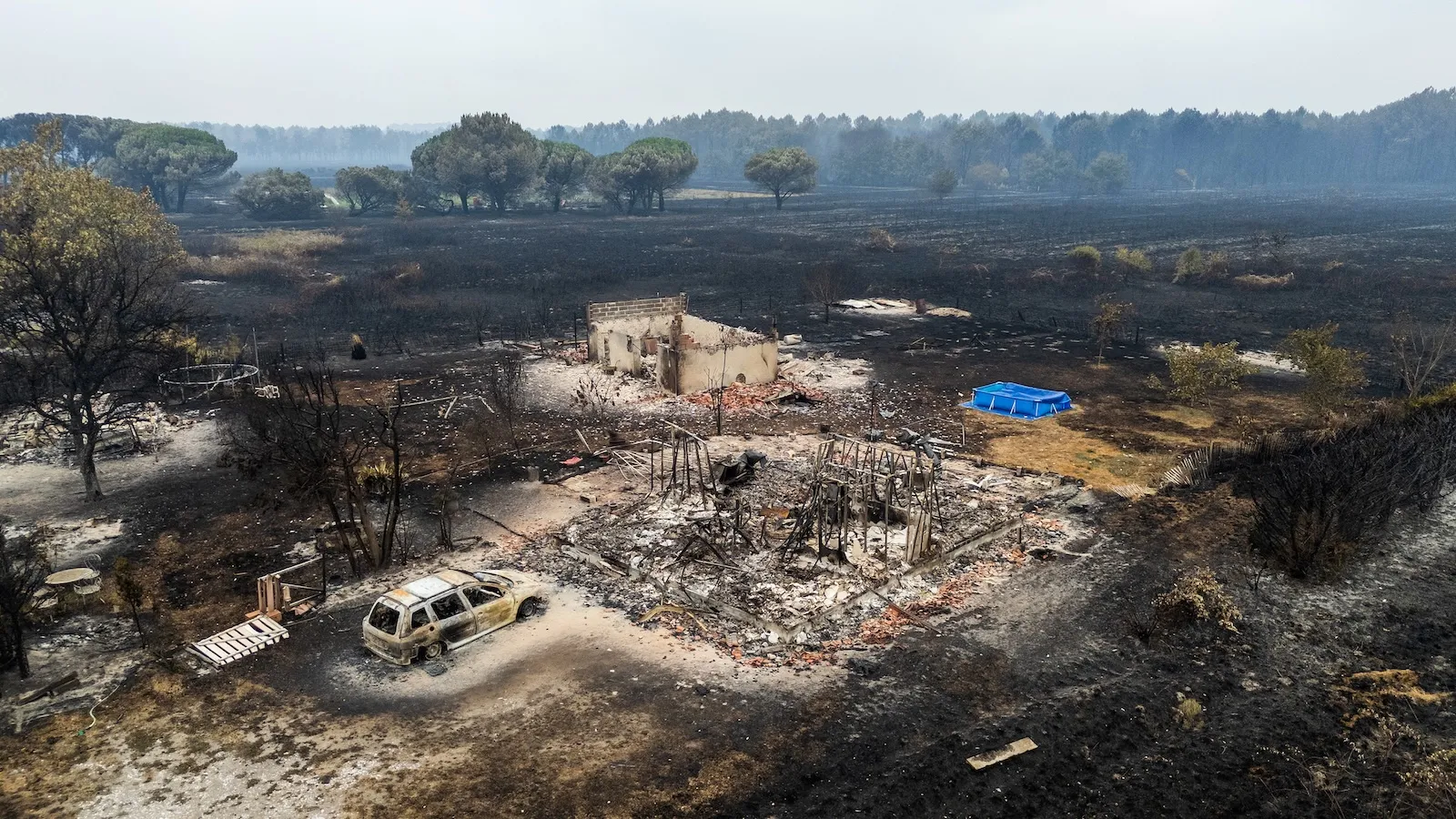
A destructive wildfire season is unfolding across France and Spain, with over 300,000 people displaced at the height of the crisis. Approximately 430,000 hectares have burned so far this year—roughly 100,000 more than the same period last year with two months remaining in the fire season. In Spain alone, the burned area is roughly equivalent to the size of London.
Scientific analysis released Thursday by World Weather Attribution, a nonprofit that studies the connection between global warming and extreme weather events, indicates that human-induced climate change made fire-prone conditions at least twice as likely in France and at least 20 times as likely in central Spain. The research emphasizes that this represents part of a broader pattern rather than an isolated event. Months of consecutive heat waves and extended drought preceding the wildfires created conditions that dried out vegetation and transformed landscapes into highly flammable terrain.
Multiple factors converged to fuel the fires. A rainier-than-normal winter in January and February prompted vegetation growth in spring, which subsequently dried out during an extended drought—a phenomenon researchers attribute to climate change’s effect on atmospheric moisture patterns. Additionally, landscape management decisions in both countries may have exacerbated conditions. In France, the outbreak centered on the Landes de Gascogne, a region with extensive timber plantations that research shows can be twice as flammable as natural forests. Abandoned farmland and reduced cattle grazing in both nations also contributed to accumulation of dry vegetation.
Rural communities dependent on farming and tourism have suffered the greatest impact, with major consequences expected for regional livelihoods. Beyond the wildfires themselves, extreme heat has created additional devastation, including June being the hottest month ever recorded in Western Europe, which caused nuclear reactor and train line shutdowns while killing thousands of people. Forecasters project additional heat surges as soon as this weekend and continuing through mid-August, with no near-term drought relief anticipated. A weak cold front may provide temporary relief, but heightened wildfire risk is expected to persist across France, Spain, and other parts of Central and Western Europe including Germany and Hungary.
Article Attribution | Read More at Article Source
Article summary produced by Claude AI