

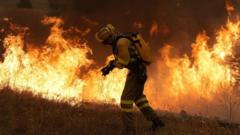
Australia is leveraging both cutting-edge technology and Indigenous ecological knowledge to address its severe wildfire challenge, with international recognition of its firefighting expertise growing amid escalating global fire crises.
Professor Marta Yebra, who leads the Bushfire Research Centre of Excellence in Canberra, has spearheaded an innovative project merging millennia-old Indigenous practices with satellite imagery. The center was established following the Black Summer fires of 2019-20, which devastated an area comparable to the United Kingdom’s size. Yebra’s team utilizes satellites, drones, and artificial intelligence to detect fires while incorporating knowledge from experienced firefighters and Indigenous communities.
A key component of this approach involves Indigenous fire management practices, particularly cultural burning, a longstanding tradition where controlled, small blazes prevent fuel accumulation across landscapes. Adrian Webster, who learned to read the environment from his elders on New South Wales’s south coast, verifies satellite data by observing physical indicators such as plant color, scent, and tree canopy density. Yebra noted a “remarkable agreement” between Webster’s local knowledge and satellite information, demonstrating the effectiveness of combining Indigenous expertise with Western science. The practice of cool fires dates back 60,000 years and creates patchy landscapes that naturally resist large-scale fire spread.
Modern firefighting techniques employed across Australia include prescribed burns conducted during cooler months and backburning operations that deliberately strip vegetation ahead of advancing fires. Drones have become increasingly critical, enabling rapid fire assessment, equipment delivery, and damage evaluation. Fire chiefs note that longer fire seasons and shifting weather patterns have compressed the operational windows for such controlled burns, particularly as suburban expansion pushes residential areas closer to bushland.
Australia’s experience is gaining international relevance as wildfires intensify globally. France recently requested Australian firefighter assistance for record-breaking blazes, marking the country’s first such appeal. Australian teams regularly deploy to the United States and Canada, with increasing recognition that effective fire management requires formal international networks and resource-sharing arrangements. Fire leaders emphasize that while forests and climates differ globally, wildfire occurrence in previously unaffected regions demands coordinated international responses and knowledge exchange.
Article Attribution | Read More at Article Source
Article summary produced by Claude AI