

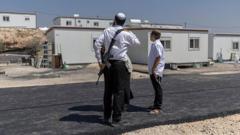
Israel has opened tenders for approximately 1,200 new settlement homes in the E1 area of the occupied West Bank, located east of Jerusalem. The announcement has sparked widespread international criticism, with the United Nations secretary general characterizing the development as an “existential threat” to a future Palestinian state. A coalition of nations including the United Kingdom, France, Germany, Italy, and Canada issued a joint statement calling the plans “unacceptable” and warning they would fracture the territorial cohesion of the West Bank.
Settlements in the occupied West Bank are deemed illegal under international law. Since 1967, Israel has established approximately 160 settlements housing around 700,000 residents in the territory. The pace of settlement construction has accelerated notably since 2022, coinciding with Netanyahu’s return to power leading a right-wing coalition focused on settler interests. Satellite imagery analysis has documented substantial construction activity at multiple settlement locations, including approximately 185 new buildings in the Tzofim settlement since 2022.
The E1 project carries particular strategic significance due to its geographical positioning. Development of the area would effectively divide the West Bank into two sections and isolate East Jerusalem from surrounding territory. Critics argue the project would sever connections between the northern and southern portions of the West Bank and obstruct the formation of a geographically unified Palestinian state centered on the cities of Ramallah, East Jerusalem, and Bethlehem.
Beyond settlement expansion, administrative control of the West Bank has increasingly shifted from military to civilian authority under Finance Minister Bezalel Smotrich, a far-right politician who has explicitly stated his objective to prevent Palestinian statehood. This transition has accompanied extensive road construction throughout the territory, linking settlements while bisecting Palestinian communities. In May, the Israeli government allocated over a billion shekels for additional West Bank road projects intended to strengthen territorial control.
The tender announcement precedes Israeli elections scheduled for October. Observers suggest settlement expansion may serve dual purposes: appealing to the government’s political base while establishing irreversible “facts on the ground” that could constrain future policy choices regardless of electoral outcomes. Palestinian leaders and international supporters of Palestinian statehood have expressed mounting concerns that cumulative settlement developments will render Palestinian independence unachievable.
Article Attribution | Read More at Article Source
Article summary produced by Claude AI