

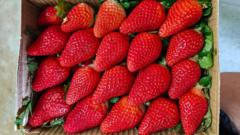
India’s strawberry industry, concentrated in the mountainous Mahabaleshwar region of western India, currently depends entirely on plant varieties imported from California, Florida, Italy, and Spain. The region accounts for approximately 85% of India’s strawberry cultivation, benefiting from its high altitude and cool growing season. However, the reliance on overseas varieties presents challenges for farmers who must purchase new plants annually at significant cost while navigating weather-related crop losses.
Research institutions are working to change this dependency. Mahatma Phule Krishi Vidyapeeth and the Bhabha Atomic Research Centre have partnered on a breeding program using controlled gamma irradiation to develop India’s first indigenous strawberry variety that combines desirable traits like large fruit size and firm texture with climate resilience suited to Indian conditions. Researchers acknowledge the process may take 10 to 15 years but are meanwhile assisting farmers through research on optimized planting schedules and fertilizer recommendations specific to local conditions.
Meanwhile, larger farming operations are adopting technological solutions to mitigate weather risks and improve yields. Some farms have transitioned to hydroponic systems and semi-open polyhouses that provide year-round growing capabilities and precise control over water, nutrients, and climate. Others employ weather monitoring towers with artificial intelligence to predict rainfall and optimize pesticide application. Vertical farming techniques using stacked cultivation allow significantly increased plant density per acre.
Smaller farms face greater obstacles in implementing such technologies due to capital requirements and financial risk. Some have found alternative approaches, including agritourism initiatives that allow direct sales to consumers while reducing middlemen. The sector remains labor-intensive and weather-dependent, presenting ongoing challenges for farmers seeking profitability alongside the broader industry transition toward domestic plant varieties and modern cultivation methods.
Article Attribution | Read More at Article Source
Article summary produced by Claude AI