

Iran maintains effective control over two critical maritime energy transit routes—the Strait of Hormuz and the Bab el-Mandeb Strait—a situation that has prompted Western and regional powers to explore alternative export corridors. The Iranian government signaled its willingness to close these waterways if threatened, and following military operations earlier this year, has moved to formalize its control over these strategic passages.
In response, the U.S. and Saudi Arabia have announced plans for the MERA Oil consortium, a joint venture that will construct a $5 billion integrated refinery and export facility positioned outside the Strait of Hormuz. The facility, which would include a 200,000-barrel-per-day refinery, storage infrastructure, and deepwater port capabilities, is expected to be operational by the end of 2029. Potential locations include ports on the Gulf of Oman or Arabian Sea, such as those in the UAE or Oman, providing direct access to international shipping routes while circumventing Iranian-controlled passages.
This initiative aligns with the broader India-Middle East-Europe Economic Corridor, a U.S.-backed infrastructure project initially launched in 2023 but recently redesigned to emphasize Oman as an anchor point. The corridor’s eastern maritime leg would connect Indian ports to the Arabian Gulf, while an overland rail network through Saudi Arabia and Jordan would link to Israel’s Port of Haifa for connections to Europe. U.S. planners estimate this could eventually redirect approximately 60% of container traffic currently transiting the Strait of Hormuz.
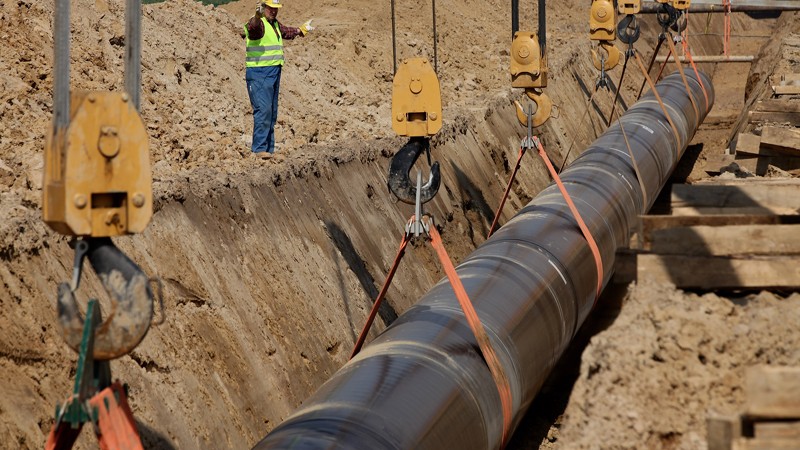
Additionally, plans are being discussed for an overland pipeline crossing the Saudi desert to the Israeli border, where the Trans-Israel Pipeline would transport oil northward to Mediterranean ports. Israeli officials have publicly supported this concept, citing the need to bypass Iranian and Houthi influence over energy exports. The proposal has also garnered support from the Trump administration, with officials noting that such infrastructure would provide strategic positioning for security forces and expanded U.S. regional influence through the Abraham Accords framework.
Article Attribution | Read More at Article Source
Article summary produced by Claude AI