

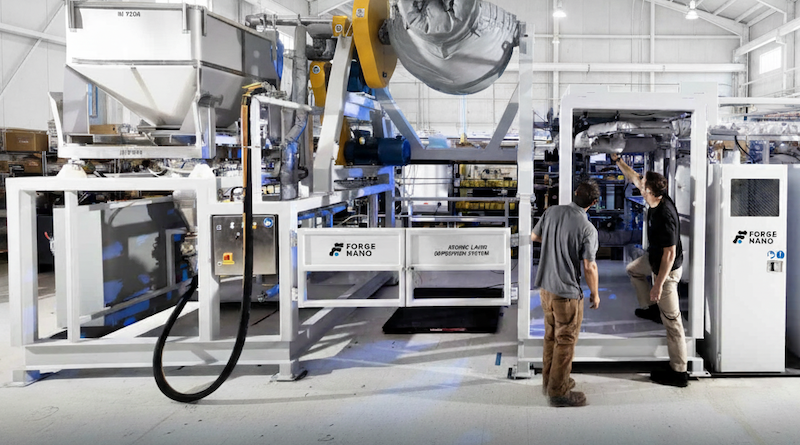
Forge Nano, a US-based advanced materials and manufacturing company, announced expansion of its lithium-ion battery operations in Morrisville, North Carolina earlier this week. The facility will grow from 100,000 square feet to approximately 315,000 square feet, with production capacity reaching 3 gigawatt-hours annually upon startup in 2028. The Trump administration provided $100 million in grant funding through the Battery Materials Processing and Battery Manufacturing program, which was authorized by the Bipartisan Infrastructure Law and initially focused on heavy-duty truck electrification alongside aerospace and national defense applications.
Assistant Secretary of Energy Audrey Robertson attended the ceremonial groundbreaking, signaling administration support for the project. The funding initiative draws bipartisan backing, with both Republican senators from North Carolina—Thom Tillis and Ted Budd—having urged the Department of Energy to prioritize the project. Forge Nano indicated its own investment in the expansion will range between $300 million and $330 million.
The facility’s production capacity of 3 gigawatt-hours annually translates to approximately 150 million battery cells per year. According to Forge Nano’s calculations, this output could support production of 10-20 million drone batteries, 34,000 electric military vehicles, 6 million radio batteries, or approximately 275 energy storage system containers annually, depending on customer demand and product mix. The expansion timeline aligns with National Defense Authorization Act battery sourcing requirements taking effect in 2028.
Further underlining the project’s defense focus, South Korea-headquartered Samsung SDI entered a conditional agreement with Forge Nano in June to purchase battery cells from the new facility. Samsung SDI will also distribute Forge Nano cells in the US as an authorized distributor. While Samsung SDI cells produced at the facility will serve automotive applications, they are designated for non-consumer markets. The partnership represents what CEO Paul Lichty characterized as a first-of-its-kind collaboration between a US battery technology company and a tier-1 battery manufacturer producing cells domestically.
Article Attribution | Read More at Article Source
Article summary produced by Claude AI