

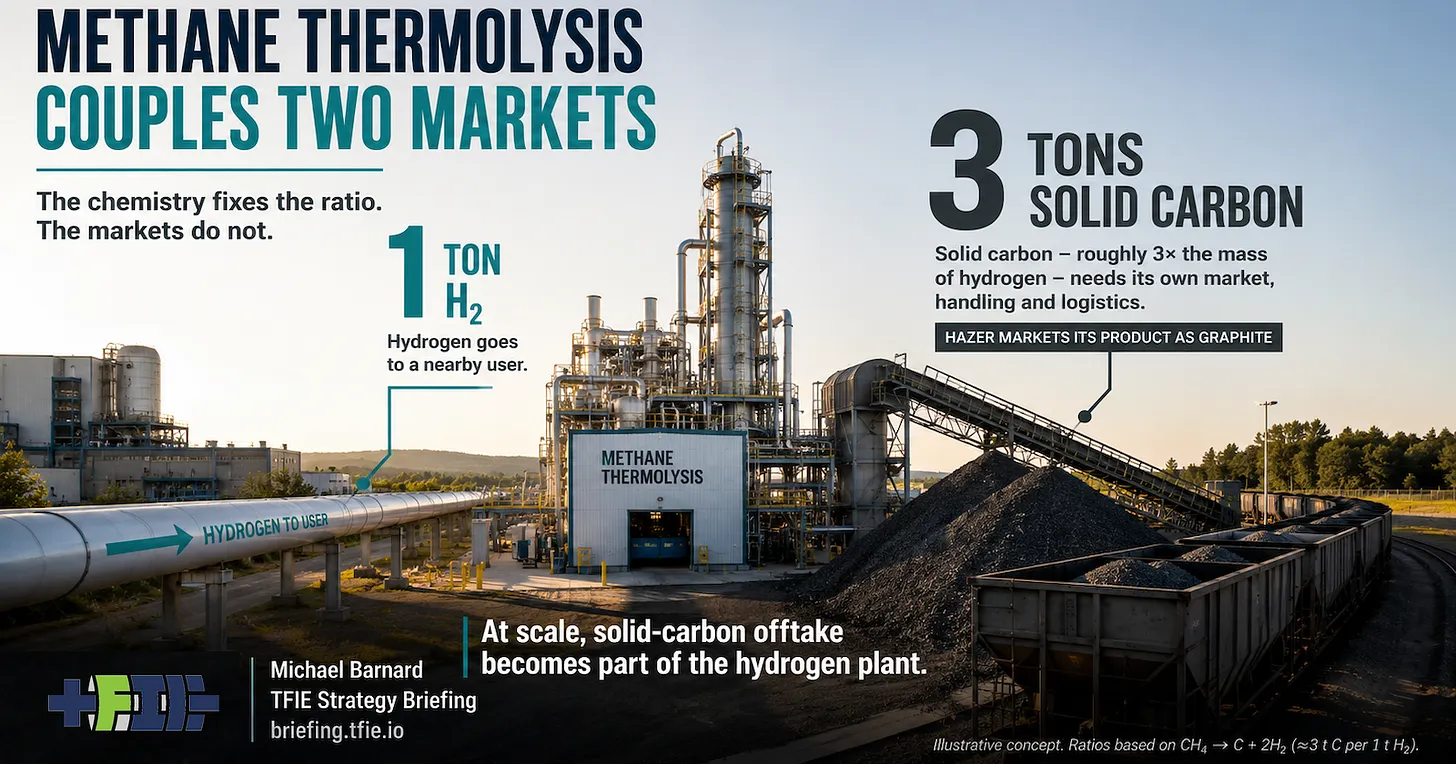
Methane thermolysis, also called methane pyrolysis, splits methane using heat rather than combustion to generate hydrogen and solid carbon, avoiding the carbon capture and storage requirements of conventional blue hydrogen production. The process has advanced from laboratory research to demonstration plants and commercial-scale engineering work, raising questions about industrial viability at scale.
A fundamental challenge emerges from the chemistry’s mass balance: industrial-scale production generates approximately three tonnes of solid carbon for every tonne of hydrogen produced. For a facility producing 300,000 tonnes of hydrogen annually, this translates to roughly 900,000 tonnes of solid carbon requiring market placement. While the resulting graphitic carbon product differs from undifferentiated soot and could theoretically serve applications in steel, batteries, asphalt and concrete, the sheer volume creates persistent demand challenges.
Steel production represents the most promising potential dual-use case, as hydrogen supports direct reduction of iron while graphitic carbon can assist in electric-arc-furnace steelmaking. However, analysis of a facility scaled to serve a 2.5-million-tonne steelworks reveals that such operations would consume only 45,000 to 63,000 tonnes of carbon annually while the methane thermolysis process would generate 340,000 to 365,000 tonnes. This leaves 80 to 90 percent of produced carbon requiring alternative markets.
The structural problem differs from conventional carbon production, where output adjusts to market demand. Methane thermolysis reverses this relationship: hydrogen demand dictates carbon production volumes and timing. Since hydrogen’s expense makes transport economically unfavorable, production occurs near hydrogen consumers, further constraining carbon placement options. Battery producers demand highly specialized graphite meeting stringent purity and morphological requirements, while asphalt and concrete markets lack the volume necessary to absorb excess production.
Despite these constraints, methane thermolysis may prove viable in specific circumstances where biogas availability, sustained industrial hydrogen demand and nearby carbon consumers align. Projects producing carbon capable of displacing emissions-intensive alternatives could generate additional value. However, investors and policymakers should evaluate the carbon stream as an independent market rather than assured coproduct revenue, accounting for qualification requirements, incumbent competition, logistics, storage and eventual market saturation.
Article Attribution | Read More at Article Source
Article summary produced by Claude AI