

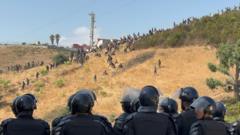
Moroccan security forces intercepted a group of migrants near the border with Ceuta, the Spanish North African territory, according to reports citing Moroccan officials and international news agencies. The detentions involved 111 individuals, primarily from sub-Saharan Africa, who were apprehended in or near Fnideq, approximately 3 kilometers from the border crossing. Police personnel, including those in riot gear, deployed tear gas to disperse clusters of migrants gathered in the surrounding hills.
The operation followed heightened security measures implemented after a substantial migration event that took place two weeks earlier. During that incident, roughly 78,000 people arrived in Ceuta by sea within hours, resulting in significant casualties. Moroccan authorities and Spanish officials had raised security alert levels after detecting social media communications calling for a coordinated crossing attempt during the weekend. Morocco’s government announced monitoring of these digital messages and threatened legal action against organizers and participants.
Spain and Morocco both reinforced their border presence in response to the threatened surge. Moroccan forces positioned military personnel, naval vessels, and aerial surveillance equipment at the boundary, while Spain deployed more than 1,500 security officers to the area. Infrastructure upgrades included installation of a metal barrier and floating obstruction at key entry points. Spanish newspaper accounts indicated security presence increased substantially compared to preceding days.
The migration crisis has created diplomatic friction across Europe. Italy suspended border-free travel provisions with Spain and implemented checkpoint inspections, with support from Finland and Denmark, while the Czech Republic suggested suspending Spain’s participation in the arrangement. Spain disputed the actions, emphasizing that Ceuta exists outside the standard border-free zone and that migrants could not proceed to mainland Europe. Italy’s foreign ministry characterized its measures as precautionary surveillance rather than punitive action, attributing the underlying migration pressures to conditions in Morocco rather than concerns about Spanish territory.
Article Attribution | Read More at Article Source
Article summary produced by Claude AI