

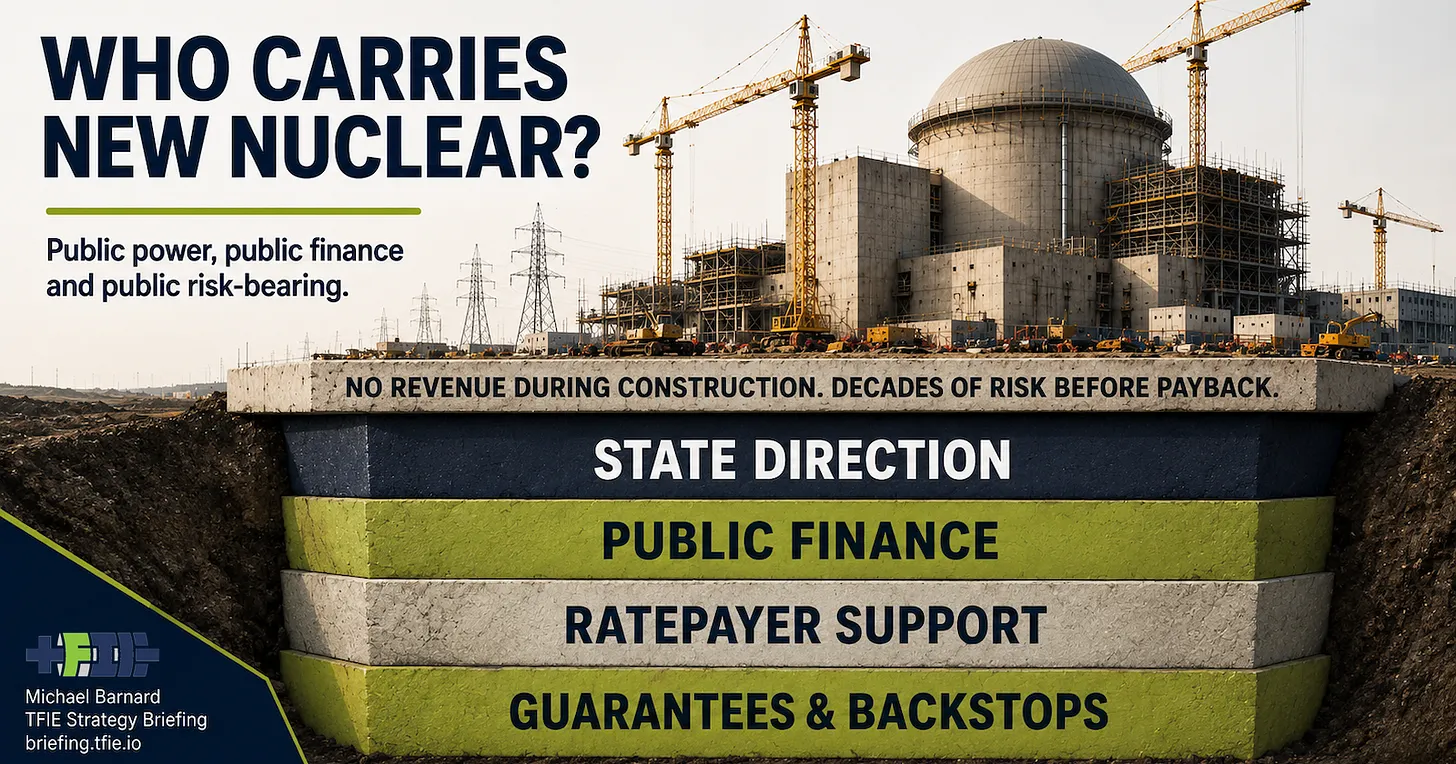
Nuclear energy produces low-carbon electricity reliably over decades, yet countries attempting to develop new reactor capacity through traditional private project finance consistently encounter obstacles. Analysis of recent nuclear programs reveals that successful large-scale deployment occurs when governments manage technology selection, arrange financing structures, regulate development, and commit to multiple projects that enable learning across construction cycles.
The fundamental challenge stems from nuclear’s financial characteristics. Gigawatt-scale reactors require billions in capital years before generating electricity, creating extended periods where financing costs accumulate without offsetting revenue. Engineering delays, regulatory shifts, and supply-chain disruptions concentrate within single massive assets rather than dispersing across numerous smaller installations, making nuclear economically distinct from modular technologies like solar and wind.
Recent European examples illustrate this pattern. Britain’s Hinkley Point C has experienced mounting cost and schedule pressures despite securing long-term revenue protections. The subsequent Sizewell C restructuring did not attract private investors willing to accept construction risk at lower cost. Instead, the financing model shifted to incorporate government equity, cost recovery guarantees during construction, and explicit public support to distribute risk before operation begins. Czechia’s Dukovany expansion employs similar mechanisms through state loans, revenue stabilization, and majority state ownership of the project company.
Successful nuclear programs also require standardization that competitive markets do not naturally produce. Leading construction efforts settle on proven designs, minimize customization, retain experienced teams, and build sufficient units for repetition benefits to accumulate. China’s nuclear sector, despite possessing state capital, integrated utilities, engineering capability, and substantial electricity demand, has struggled to impose the standardization that optimal economics require. While current programs have consolidated around specific reactor families, variants persist across safety architectures and supply chains.
Comparison with China’s renewable capacity additions highlights industrial throughput differences. Adjusting for capacity factors, China’s 2025 wind and solar additions represented approximately 696 terawatt-hours of annual generation capability versus roughly 14 terawatt-hours from nuclear additions that year. Policy assessment should recognize that serious nuclear development requires patient capital, controlled design variation, sustained construction, durable supply chains, and explicit decisions regarding cost responsibility. These characteristics define national industrial policy rather than spontaneous market-driven deployment. Countries may justify such commitments for firm low-carbon generation, but the commitments should be transparent, opportunity costs calculated, and nuclear evaluated against alternatives on a comprehensive basis.
Article Attribution | Read More at Article Source
Article summary produced by Claude AI