

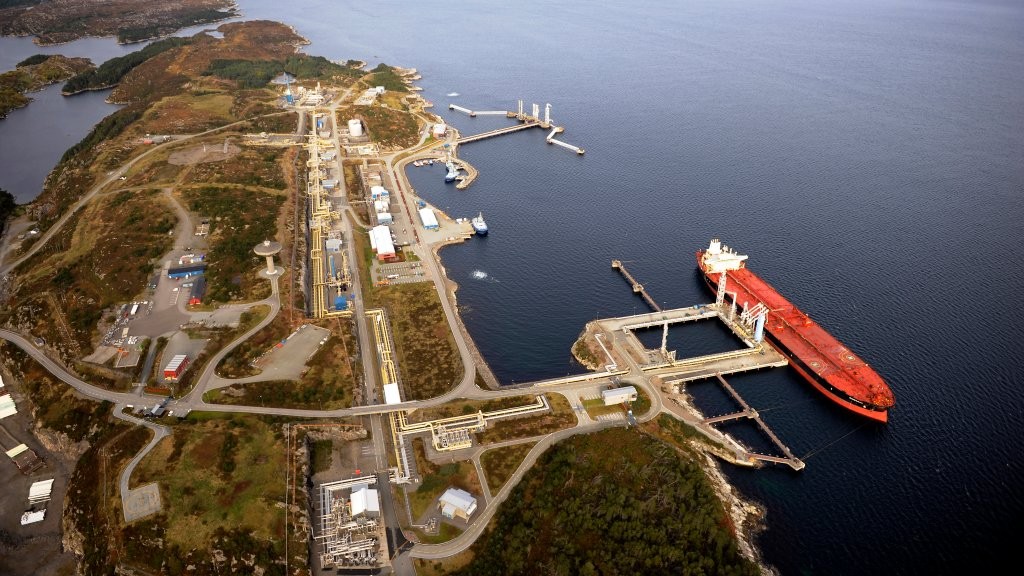
Norway’s crude oil production averaged 1.776 million barrels per day in July, according to preliminary data from the Norwegian Offshore Directorate. Including natural gas liquids and condensate, total liquids production reached 1.976 million barrels per day. This marked a significant decline from the previous year, with crude output falling approximately 195,000 barrels per day, or nearly 10%, compared to July 2025 when the country produced 1.971 million barrels per day of crude. Total liquids production contracted by roughly 197,000 barrels per day, representing a 9.1% decrease from 2.173 million barrels per day in the prior-year period.
The timing of Norway’s production decline carries particular significance given broader global supply dynamics. The International Energy Agency reports that approximately 8.3 million barrels per day of Gulf production remained offline in July due to severely restricted traffic through the Strait of Hormuz, limiting regional exports. Global supply remained 6.3 million barrels per day below year-earlier levels despite some monthly increases. The IEA has also reduced its third-quarter oil supply projection by 1.7 million barrels per day following renewed hostilities and maritime disruptions. In this constrained environment, markets are becoming increasingly reliant on production sources outside the Persian Gulf that can reach refiners without navigating geopolitically sensitive chokepoints.
Monthly comparisons also reveal weakness, with Norwegian crude production declining 47,000 barrels per day from June’s revised figure of 1.823 million barrels per day. Analysts note that while such monthly variations might ordinarily be absorbed in well-supplied markets, the decline gains consequence given current reliance on inventories, emergency reserves, and alternative export routes to offset Middle Eastern supply disruptions. Norwegian crude’s value to current markets exceeds its share of global supply due to proximity to European refining infrastructure and insulation from maritime constraints affecting Middle Eastern exports.
Observers caution against treating July’s figures as evidence of structural decline. July 2025 represented an exceptionally strong comparison period, with production running 9% above forecasts. Norwegian output also typically fluctuates during the summer maintenance season due to planned shutdowns and operational variations. Through June, cumulative oil production ran 5.7% above forecasts, providing a production cushion that the July decline has only partially eroded. The market’s assessment of longer-term implications will depend on whether production recovers following the maintenance season or remains below 1.8 million barrels per day, potentially reducing the reliable supply buffer markets increasingly require amid global constraints.
Article Attribution | Read More at Article Source
Article summary produced by Claude AI