

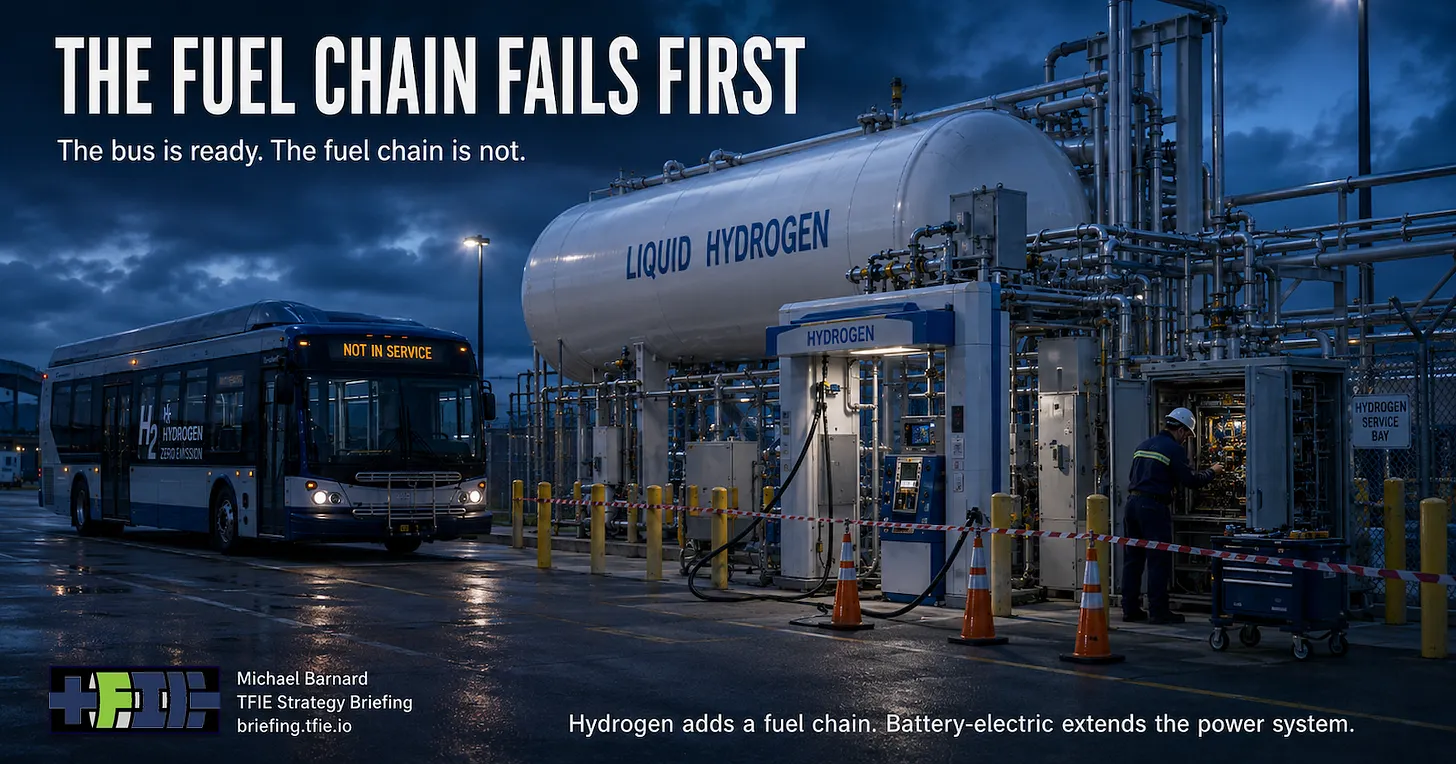
The Orange County Transportation Authority announced a $27.6 million investment in hydrogen infrastructure to support expansion of its fuel-cell bus fleet from 10 to 50 vehicles. The announcement appears to represent standard fleet growth, but the agency’s history with hydrogen fueling reveals underlying complications.
OCTA opened a hydrogen station at its Santa Ana base in 2020, designed to serve 40 to 50 buses daily. The facility became inoperable after OCTA and Air Products failed to negotiate a new commercial agreement for leased liquid-hydrogen equipment. Air Products removed its tank and vaporization systems in January 2026, rendering the station unusable despite OCTA’s fuel-cell buses still having significant remaining service life.
The operational consequences were substantial. OCTA’s fuel-cell buses traveled approximately 270,462 miles in 2024 but only 14,232 miles in 2025, representing a decline of roughly 95 percent. The agency relied on off-site commercial stations and temporary mobile fueling while addressing the depot infrastructure gap. By contrast, OCTA’s battery-electric bus fleet experienced no deployment reductions due to charging infrastructure issues, with charging infrastructure costing approximately $6 million compared to hydrogen’s greater complexity.
The new Garden Grove station represents a comprehensive commitment beyond a simple fueling dispenser. The $27.6 million contract includes design, construction, facility modifications, hydrogen supply, operations, maintenance and training services. This reflects the specialized requirements of establishing a complete fuel pathway encompassing production, compression or liquefaction, transport, storage and maintenance. Combined with previous hydrogen investments, total refueling expenditures have exceeded $100 million.
The expansion strategy follows OCTA’s existing hydrogen commitment despite the previous system’s failure and demonstrated superiority of battery-electric alternatives within the same agency. Industry observers note that hydrogen transit fleets require agencies to establish and maintain a secondary energy-delivery system for relatively small bus counts, whereas battery-electric infrastructure extends existing regional electricity systems. The procurement experience demonstrates how apparent advantages of rapid refueling become offset by requirements for specialized infrastructure and sustained fuel-supply relationships.
Article Attribution | Read More at Article Source
Article summary produced by Claude AI