

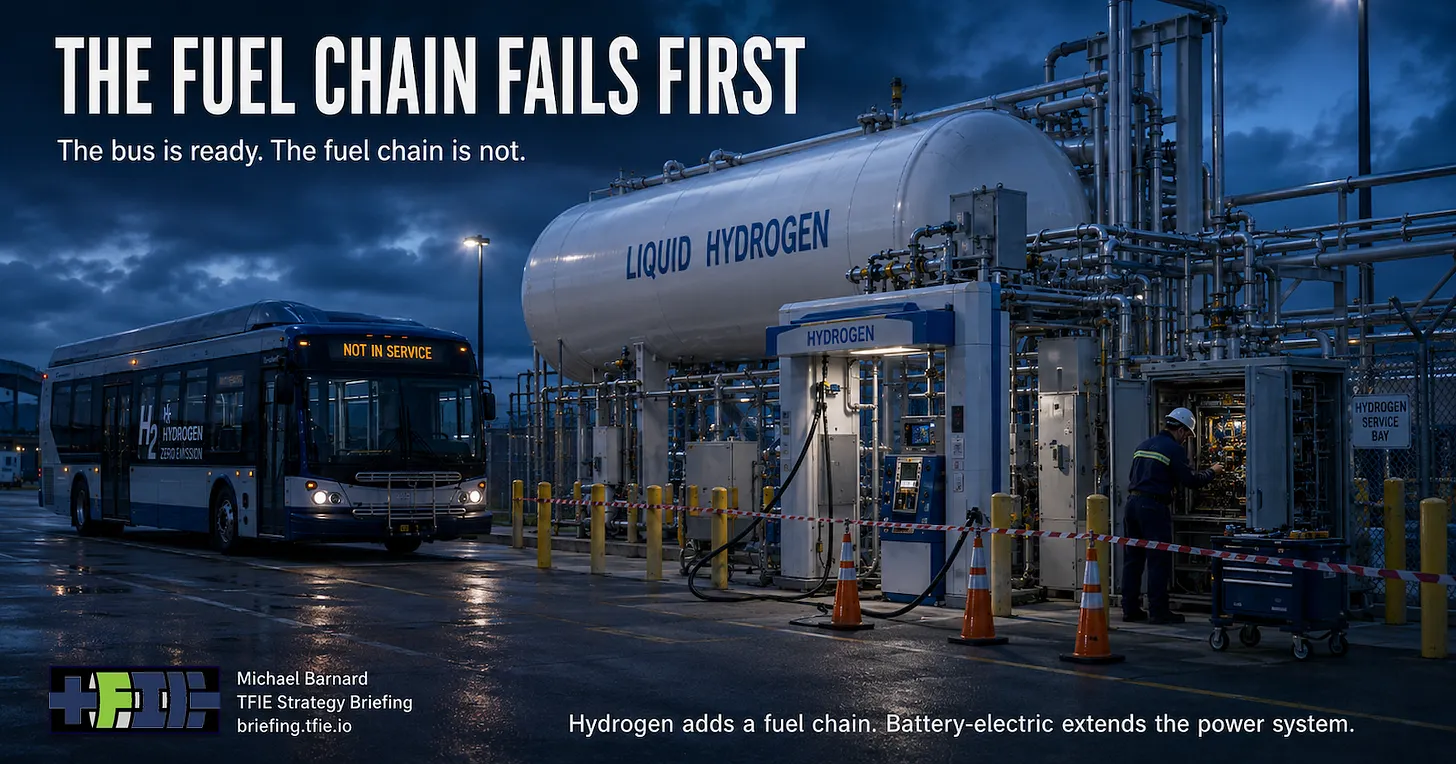
The Orange County Transportation Authority announced a $27.6 million investment in hydrogen infrastructure to support expansion of its fuel-cell bus fleet from 10 to 50 vehicles. The funding will cover design, construction, facility modifications, hydrogen supply, operations, and maintenance at a new station in Garden Grove.
OCTA’s hydrogen program has faced significant challenges. The agency opened a substantial hydrogen fueling station at its Santa Ana base in 2020, designed to handle 40 to 50 buses daily. However, when OCTA and Air Products failed to negotiate a new commercial agreement for leased liquid-hydrogen equipment, Air Products removed its tank and vaporizers in January 2026, leaving the station unusable despite the buses still having years of operational life remaining.
The impact on bus operations was dramatic. OCTA’s ten fuel-cell buses traveled 270,462 miles in 2024 but only 14,232 miles in 2025, representing a decline of nearly 95 percent. The agency was forced to rely on off-site commercial stations and temporary mobile fueling while working to restore depot capacity. In contrast, OCTA’s battery-electric buses experienced no operational disruptions due to charging infrastructure limitations, with their charging system requiring approximately $6 million in capital investment.
The broader context reveals structural challenges with hydrogen fuel systems for transit agencies. A functioning hydrogen program requires coordinated infrastructure encompassing production, compression or liquefaction, transport, storage, specialized maintenance, and dispensing—representing a complete energy-delivery system parallel to existing regional electricity networks. Battery-electric buses, by comparison, leverage existing electrical infrastructure serving buildings, industry, and vehicles throughout service areas.
OCTA’s cumulative spending on hydrogen refueling infrastructure has exceeded $100 million. The agency’s experience provides a case study in how initial vehicle purchases commit agencies to substantial ongoing investments in specialized fuel-supply systems, particularly when alternative propulsion technologies demonstrate greater reliability and lower costs within the same operational context.
Article Attribution | Read More at Article Source
Article summary produced by Claude AI