

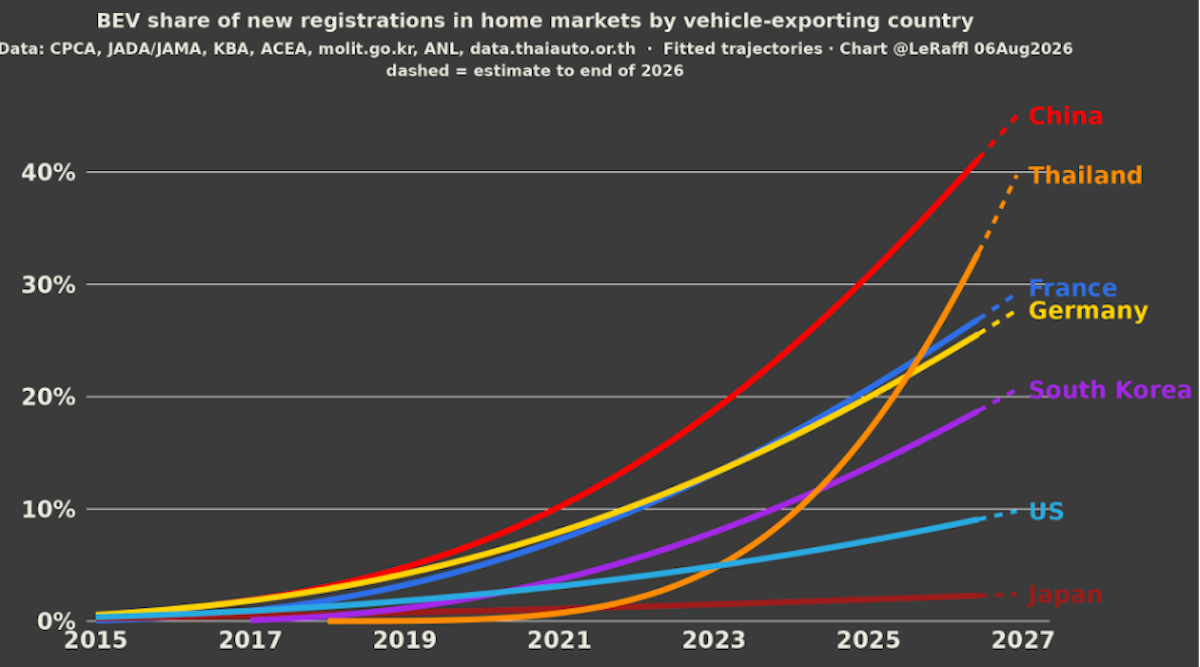
Europe posted its strongest half-year battery-electric vehicle result on record, with BEVs capturing 20.7% of EU registrations across the first half of 2026, up from 15.6% a year prior. Sales volumes topped 1.24 million units, representing a 33.7% increase compared to 2025. Individual markets showed varying strength, with France achieving a 29.6% BEV market share and several smaller European nations surpassing China’s domestic penetration rate. Germany reached approximately 25% BEV share for the first half and 28% in June, marking the first month battery-electric vehicles outsold all other fuel types in the country.
However, the headline growth obscures a more complex reality. Positioned among major vehicle-exporting nations by domestic BEV share, Europe ranks squarely in the middle tier, well ahead of Japan and the United States but clearly trailing China and increasingly Thailand. China’s domestic BEV share reached approximately 42.8% in June 2026, with combustion-vehicle sales collapsing faster than battery-electric options can replace them. Thailand has restructured its incentive framework to pivot toward EV exports after domestic oversupply, transforming what was historically a Japanese-dominated internal combustion engine market into a Chinese-led electric vehicle export base.
The core issue extends beyond consumer demand or charging infrastructure, which data shows now comfortably outpace EV sales across nearly the entire bloc. Instead, Europe’s constraint stems from its pace of industrial and policy transition. Full hybrids and plug-in hybrids collectively account for 47.1% of EU registrations, masking the slower underlying battery-electric transition. European manufacturers including Volkswagen, BMW, Mercedes-Benz, Stellantis and Renault have issued profit warnings or reduced European production despite record BEV sales, indicating these companies are not capturing growth in their own markets. Chinese brands have doubled their European market share year-on-year to approximately 11% as of June, with forecasts suggesting this could reach 16% by 2030.
The structural challenge reflects Europe’s loss of its most profitable export market as China completed electrification faster than European manufacturers adapted. Simultaneously, European brands face competition from manufacturers that gained scale experience in China’s accelerated transition. Prolonging hybrid and plug-in hybrid volumes maintains supply-chain commitments to internal combustion engine production, slowing manufacturers’ shift to full electrification. Industrial and regulatory levers remain available, including strengthened CO₂ standards, subsidy redirection toward battery-electric vehicles specifically, and resistance to extended compliance timelines, but the window for decisive action narrows annually as competing regions advance their structural transitions.
Article Attribution | Read More at Article Source
Article summary produced by Claude AI