

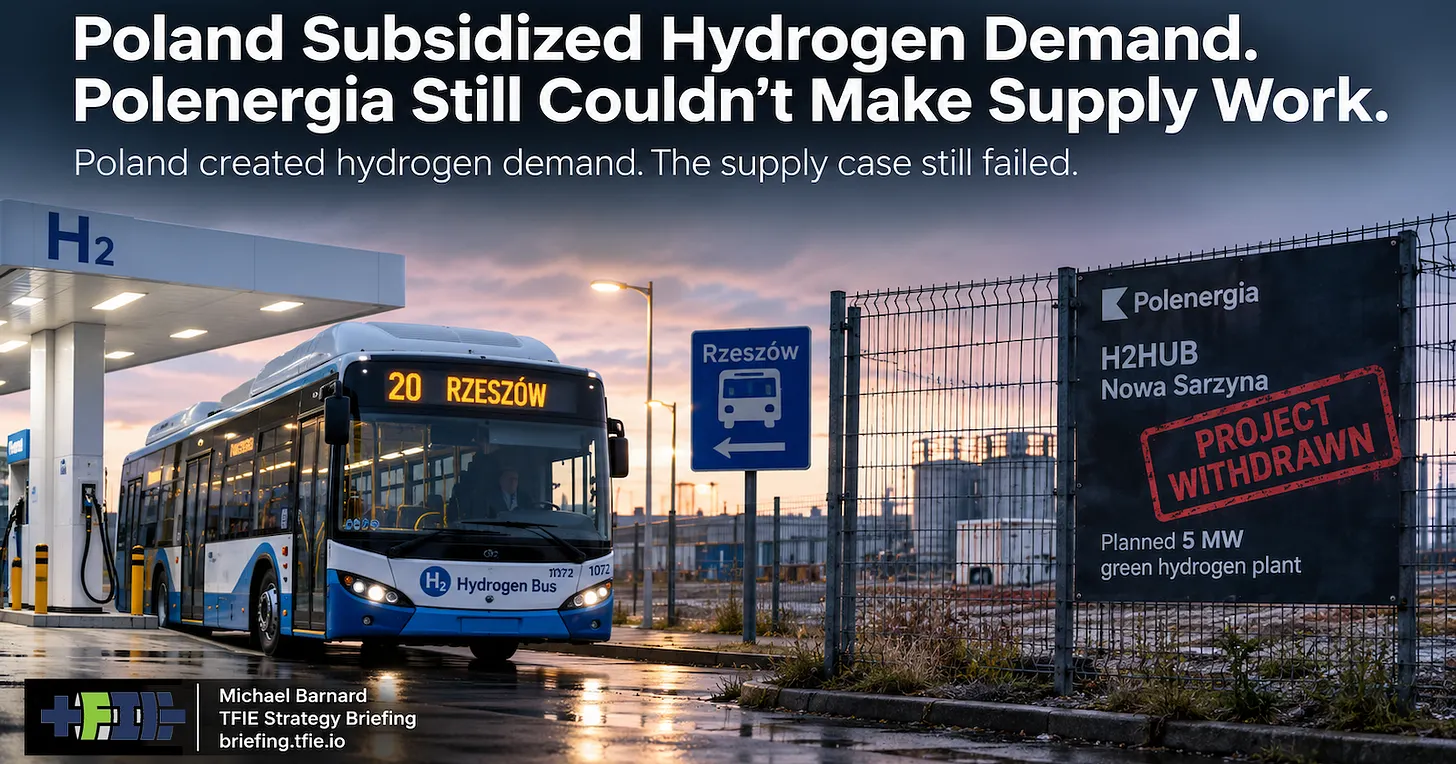
Poland implemented a comprehensive industrial policy to develop a domestic hydrogen industry by creating demand through public subsidies for hydrogen buses, refueling infrastructure, and renewable-hydrogen production projects. By April 2026, the country had 153 hydrogen buses registered with 140 in service and 107 more contracted, moving beyond typical demonstration phases.
Polenergia, Poland’s largest private energy company, advanced a 5 MW renewable-hydrogen facility in Nowa Sarzyna further than most hydrogen ventures reach. The project included distribution and refueling infrastructure, with electrolyzer equipment from Hystar and support from the International Finance Corporation and Polish public funding. By October 2024, the initiative had obtained building permits and completed factory acceptance testing on all eight electrolyzer stacks—an unusually advanced stage for hydrogen projects. The company won a competitive municipal tender to supply hydrogen for 20 fuel-cell buses operated by Rzeszów’s transit authority, securing a 15-year supply agreement valued at approximately PLN120 million.
Despite this convergence of favorable conditions—government-backed demand, an established energy supplier, local permitted production, contracted equipment, and a long-term municipal customer—Polenergia withdrew from the project in January 2025. The company cited legal concerns related to the tender process and risk that it could not meet delivery timelines. However, the decision coincided with a broader corporate reassessment of the company’s hydrogen strategy, with subsequent disclosures citing green-hydrogen market development, project investment risk, and constrained financing options.
The situation illustrates a fundamental tension in hydrogen transportation policy. Municipalities purchasing fuel-cell buses create long-term hydrogen requirements regardless of whether local production becomes viable or economically competitive. Public subsidies can make vehicles affordable at purchase without ensuring the resulting fuel supply system remains competitive or sustainable over its operational lifetime. Poland already consumes substantial fossil-derived hydrogen in refining and chemicals production—concentrated existing markets where replacing high-carbon sources represents genuine decarbonization. Hydrogen buses, by contrast, require subsidies to generate demand against mature direct-electric alternatives. The Rzeszów case suggests that creating transport demand through subsidies does not guarantee economically viable local supply will materialize.
Article Attribution | Read More at Article Source
Article summary produced by Claude AI