

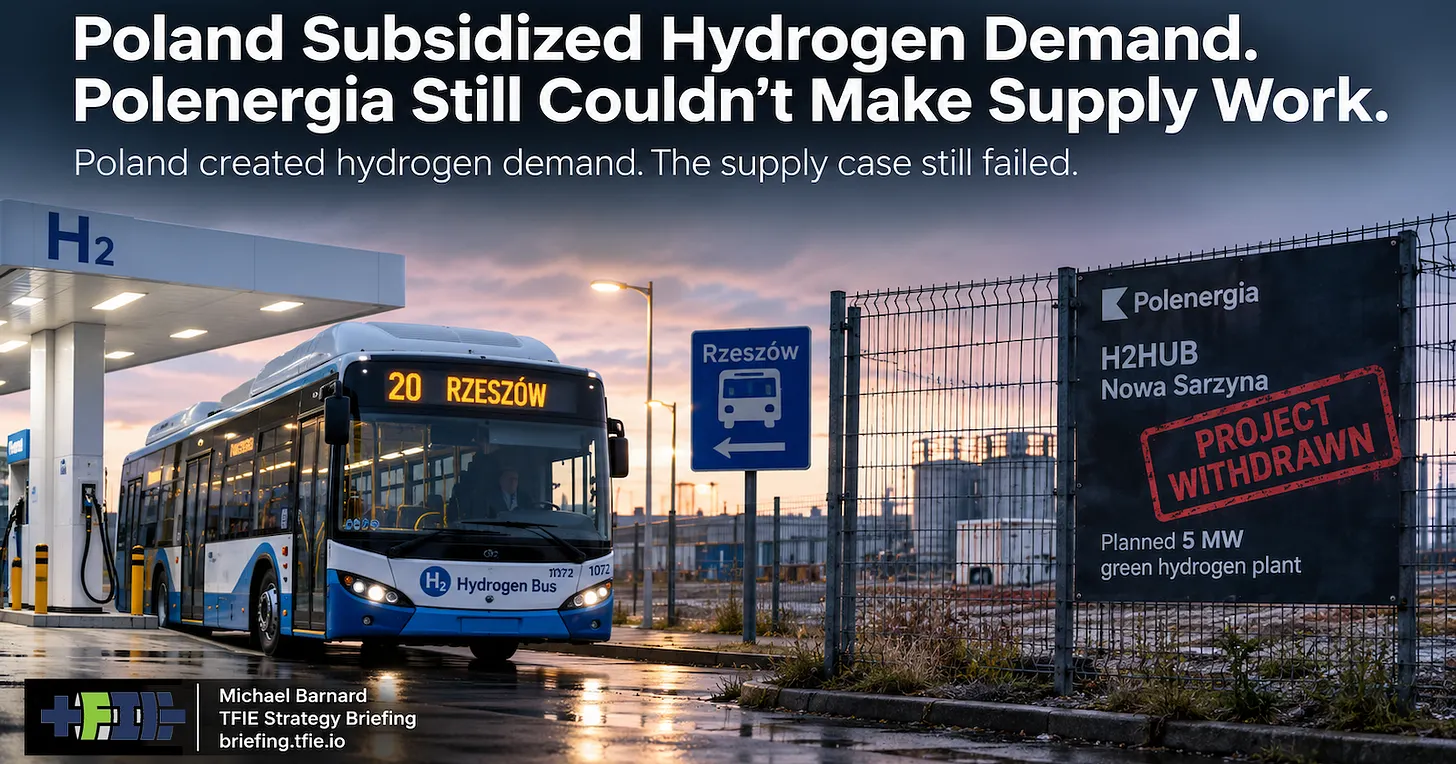
Poland pursued an industrial policy designed to create domestic hydrogen market conditions by subsidizing fuel-cell buses for public transit, supporting refueling infrastructure, and offering financial backing for renewable hydrogen production facilities. By April 2026, the country had registered 153 hydrogen buses, with 140 already operational and another 107 on order, representing a transition beyond isolated demonstration projects.
Polenergia, Poland’s largest private energy company, advanced a hydrogen production initiative further than most similar ventures. The Nowa Sarzyna project proposed a 5 megawatt renewable-hydrogen facility capable of producing approximately 500 tonnes annually, along with associated distribution and refueling infrastructure. The venture attracted support from the International Finance Corporation for development expenses and equipment financing, with Polish government funding available for related refueling stations. By October 2024, the project had secured building permits and completed factory acceptance testing on all eight electrolyzer stacks—an unusually advanced stage for hydrogen infrastructure projects.
The initiative appeared to have achieved the conditions needed for success. Rzeszów’s municipal transit operator placed an order for hydrogen to supply 20 fuel-cell buses, and Polenergia won a competitive 15-year fuel supply contract in October 2024 valued at approximately 120 million Polish zloty. This combination of government-supported demand, an established energy company, licensed local production capability, procured equipment, and a long-term municipal customer represented conditions rarely assembled in hydrogen infrastructure ventures.
However, Polenergia announced in January 2025 that it could not finalize the Rzeszów supply agreement, citing legal complications surrounding the tender process and delivery schedule risks. The decision occurred amid a broader strategic review, with the company subsequently announcing a gradual withdrawal from hydrogen transportation while citing green hydrogen market development challenges, project investment risk, and constrained financing options.
The situation illustrates a gap between government demand-creation policies and market viability. Despite subsidies enabling bus purchases and infrastructure development, municipalities were left with vehicles requiring hydrogen fuel without economical or reliable local supply. Poland’s experience suggests that establishing consumption through public financing does not necessarily result in sustainable, competitive domestic production capacity.
Article Attribution | Read More at Article Source
Article summary produced by Claude AI