

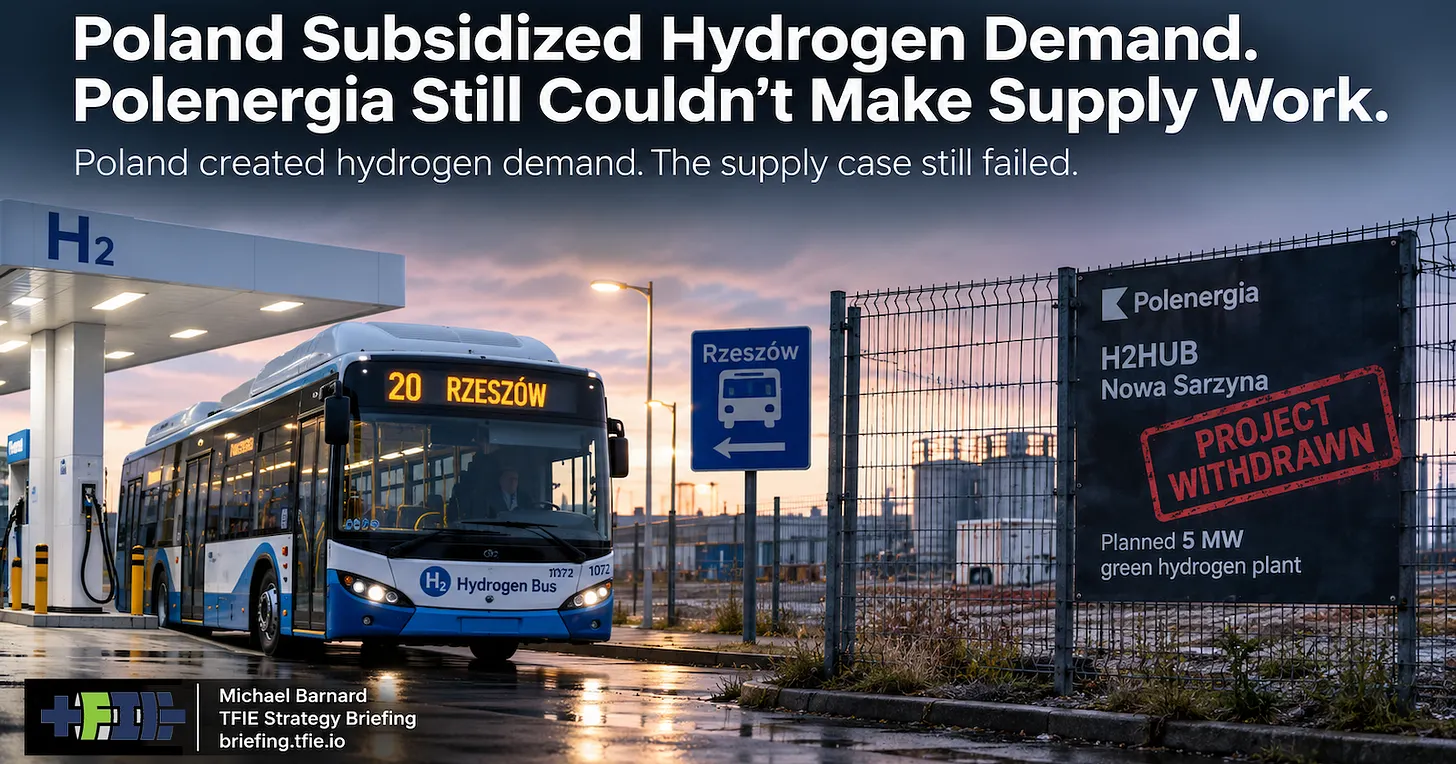
Poland implemented an industrial policy designed to create domestic hydrogen demand through public subsidies for buses, refueling infrastructure, and renewable-hydrogen production projects. By April 2026, the country had 153 hydrogen buses registered, with 140 already operational and 107 additional units under contract. The strategy aimed to establish a self-reinforcing cycle: subsidized buses would generate hydrogen demand, justify refueling stations, and support local production facilities that could eventually operate independently.
Polenergia, the nation’s largest private energy company, pursued a hydrogen project that advanced significantly further than typical industry announcements. The Nowa Sarzyna facility was designed to produce approximately 500 tonnes of renewable hydrogen annually through a 5 MW electrolyzer installation. The project secured a building permit, completed factory acceptance testing on all eight electrolyzer stacks, and had contracted equipment suppliers including Hystar and financial backing from the International Finance Corporation. By October 2024, the venture had achieved operational milestones unusual for hydrogen initiatives.
Critically, Polenergia secured a customer through a competitive tender. Rzeszów’s municipal transit operator selected the company to supply hydrogen for 20 fuel-cell buses under a 15-year agreement valued at approximately PLN120 million. This arrangement represented the type of stable, long-duration demand that hydrogen advocates have identified as necessary for project viability. All structural elements appeared to be in place: government-backed demand, an established energy company, local production capacity, permitted facilities, and public support.
In January 2025, Polenergia announced it would not proceed with the Rzeszów agreement, citing legal complications and scheduling risks. The company subsequently disclosed broader strategic reassessments, including withdrawal from hydrogen transportation, concerns about market development, project investment risk, and limited financing availability. This decision occurred despite the project’s advanced development stage and existing customer commitments.
Poland’s experience raises questions about whether demand creation alone ensures supply development. While hydrogen has established industrial uses in refining and chemicals production, bus applications require government support to compete with mature electric-vehicle alternatives. Rzeszów retained 20 fuel-cell buses and their multi-year hydrogen requirements even after its expected local supplier withdrew, leaving municipalities dependent on alternative supply arrangements.
Article Attribution | Read More at Article Source
Article summary produced by Claude AI