

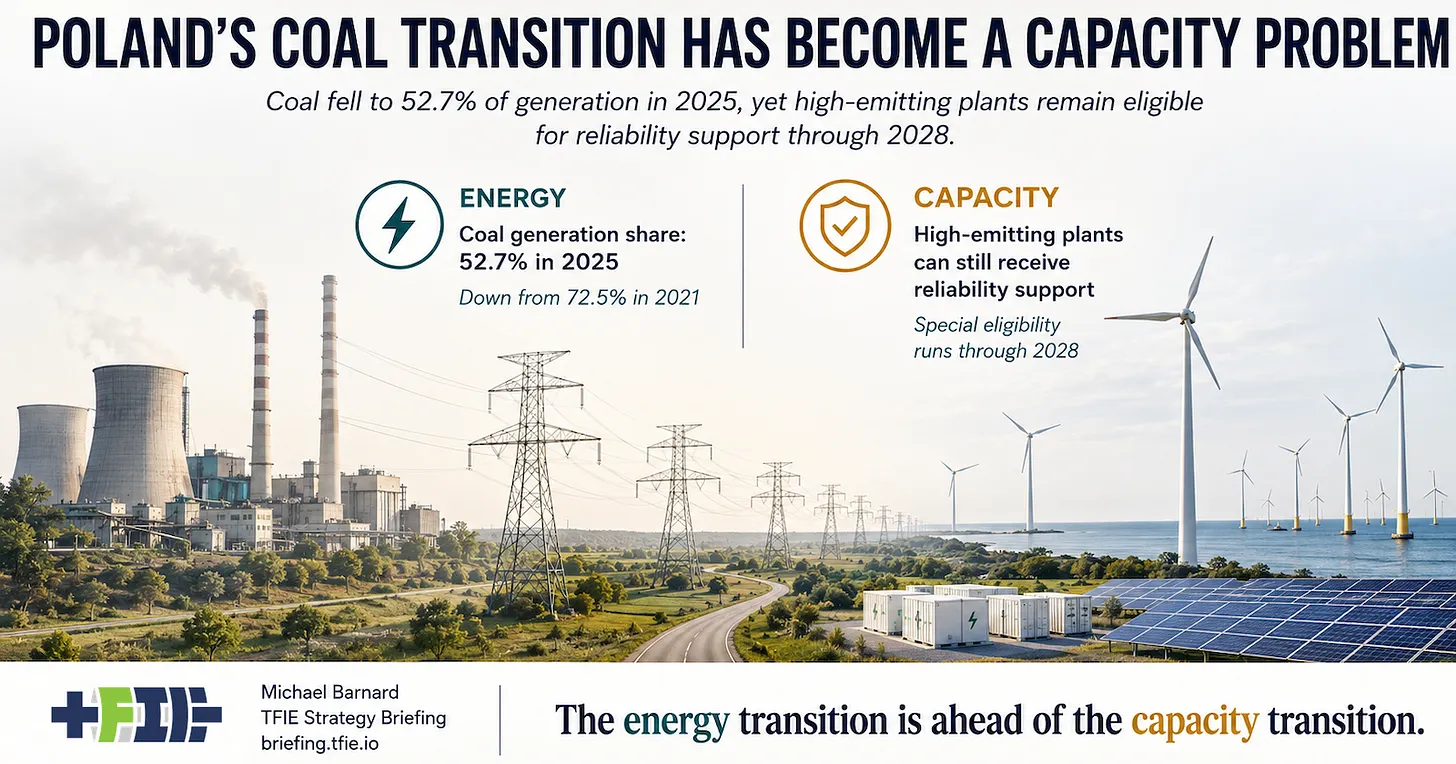
Poland’s electricity system is undergoing a significant transformation, with coal’s share of generation declining substantially over recent years. In 2021, coal provided three-quarters of the country’s electricity supply. By 2025, this figure had dropped to approximately 52.7%, while renewable sources accounted for 31.4% of generation. In multiple months during the period, coal fell below half of total generation, and renewable output exceeded coal generation for a full month in June for the first time.
The transition is not simply a one-to-one replacement of coal with renewables. Natural gas has emerged as another significant component of Poland’s evolving energy mix, recording the largest increases in generation share during both 2024 and 2025. Gas generation in 2025 reached 24.4 TWh, comparable to onshore wind at 23.8 TWh and solar at 20.3 TWh. This diversification of sources reflects the country’s broader decarbonization efforts while highlighting the complexity of transitioning away from traditional fossil fuels.
A key challenge now centers on Poland’s capacity mechanisms rather than generation volumes alone. Although coal plants generate less electricity annually, the country maintains high-emitting coal capacity through market arrangements to ensure grid reliability during peak demand periods when renewable sources may be unavailable. Poland’s capacity market permitted high-emission plants to participate in a September 2025 auction for the 2026 delivery year under special exemptions, with similar auctions planned through 2028.
The system is encountering novel problems stemming from rapid renewable expansion. In 2025, Poland curtailed 1.4 TWh of renewable electricity, double the previous year’s amount, primarily for grid balancing rather than physical constraints. This surplus generation coexists with continued need for dispatchable capacity during periods of high demand and low renewable output. Addressing these challenges requires infrastructure beyond generation alone, including transmission upgrades, energy storage, flexible demand management, and enhanced interconnections with neighboring systems. Poland’s first offshore wind farm, Baltic Power, commenced operations in July 2026 and is expected to contribute approximately 3% of current electricity demand when fully operational.
Looking ahead, the International Energy Agency projects Polish renewable generation will grow approximately 13% annually through 2030, potentially surpassing coal in annual generation in 2028 and reaching roughly 53% of total generation by that year. Coal generation is anticipated to decline at approximately 11% annually. The distinction between reducing coal’s energy contribution and eliminating its capacity role remains critical for assessing Poland’s continued progress toward a fully decarbonized grid.
Article Attribution | Read More at Article Source
Article summary produced by Claude AI