

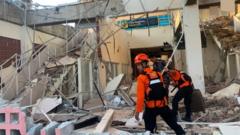
A powerful 7.7-magnitude earthquake struck the Indonesian island of Flores early on Saturday, claiming at least 38 lives according to the nation’s disaster mitigation agency. The tremor, which occurred at a shallow depth of 15 kilometers, was followed by numerous aftershocks, including one measuring 6.1 in magnitude. The shallow depth of the initial quake intensified its destructive impact on surface structures and communities throughout the affected area.
Damage assessments indicated widespread structural destruction across multiple sectors. According to preliminary reports, 54 houses sustained severe damage, along with five healthcare facilities, three places of worship, six government buildings, an educational institution, and a warehouse. The provincial government reported fatalities distributed across several districts: three deaths in Sikka province, six in Manggarai province, and five in East Manggarai province. Additional casualties and injuries continued to mount as search and rescue operations progressed. The disaster agency documented at least two individuals with serious injuries and 11 with minor injuries.
Authorities issued a tsunami warning following the initial earthquake, prompting approximately 2,000 residents to evacuate or self-relocate to higher ground. Video footage from the port in Maumere captured the quake’s destructive power, showing large concrete sections breaking away from a terminal building and striking passengers waiting to board an inter-island ferry. A gangway to a ship collapsed during the event, throwing some individuals into the water. The tsunami alert was lifted within three hours after monitoring detected no significant sea level rise.
Residents reported harrowing experiences during and after the earthquake. Accounts described severe ground shaking compared to being on a trampoline, with many residents choosing to remain outdoors due to fear of additional aftershocks damaging their homes further. Some community members were observed cooking outside their residences and gathering along roadsides after the sea receded due to the seismic activity. The mountainous and remote nature of the affected region presented challenges for comprehensive damage assessment and relief efforts.
Indonesia’s geographic location along the convergence of three major tectonic plates renders the archipelago particularly susceptible to seismic activity and volcanic phenomena. This recurring natural hazard underscores the ongoing vulnerability of communities in the region to such geological events.
Article Attribution | Read More at Article Source
Article summary produced by Claude AI