

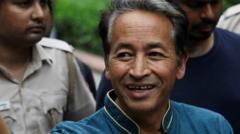
Leading activist Sonam Wangchuk has characterized the recent wave of youth-led protests in India as having substantially damaged Prime Minister Narendra Modi’s government. Speaking to the BBC, Wangchuk noted that the political atmosphere in the country has shifted markedly following large-scale demonstrations that prompted the resignation of Education Minister Dharmendra Pradhan on 25 July. According to Wangchuk, young people now possess greater confidence in their ability to influence outcomes and no longer feel compelled to passively accept government decisions.
The movement, known as the “cockroach” movement, represents one of the most significant public displays of dissent against Modi’s administration since it assumed power in 2014. The movement’s name derives from controversial remarks made by India’s chief justice, who compared unemployed young people to “cockroaches” during a court proceeding, drawing substantial criticism. Wangchuk’s personal contribution involved a 26-day fast conducted in Delhi during June and July, during which he consumed only salt and water, resulting in an 11-kilogram weight loss. He reported being forcibly hospitalized during the final six days of his fast, describing the facilities as prison-like conditions.
The demonstrations initially centered on public anger regarding leaked examination papers but evolved into broader anti-government protests representing some of India’s most significant dissent in recent years. Following the conclusion of Wangchuk’s hunger strike, the government implemented several measures including the appointment of a technology billionaire to oversee examination system reforms, establishment of fast-track courts for those accused in the leaks, and announced compensation for families of students who died by suicide following the exam question leak.
Wangchuk contends that addressing India’s education system requires fundamental restructuring. He argues that current examinations bear limited relevance to actual job market demands and that their multiple-choice format prioritizes efficiency in assessing millions of students while failing to meaningfully evaluate skills and comprehension. The activist advocates for examinations incorporating greater emphasis on practical experience and aptitude assessment, potentially encouraging schools to modify teaching methodologies. Graduate unemployment in India has remained between 35 and 40 percent over the past 25 years, indicating persistent structural challenges in the employment landscape.
Despite government measures, reports indicate that protesters continue experiencing legal proceedings, police harassment, and social media abuse despite Supreme Court directives against coercive action against those without prior criminal records. Wangchuk identifies recent electoral setbacks for the ruling BJP as evidence of governmental damage, citing the party’s loss in two of three recent by-elections including a Bihar seat held for more than 30 years. He maintains confidence in the potential for positive change and advocates for continued non-violent resistance inspired by Gandhian philosophy, while declining to pursue elected office himself.
Article Attribution | Read More at Article Source
Article summary produced by Claude AI