

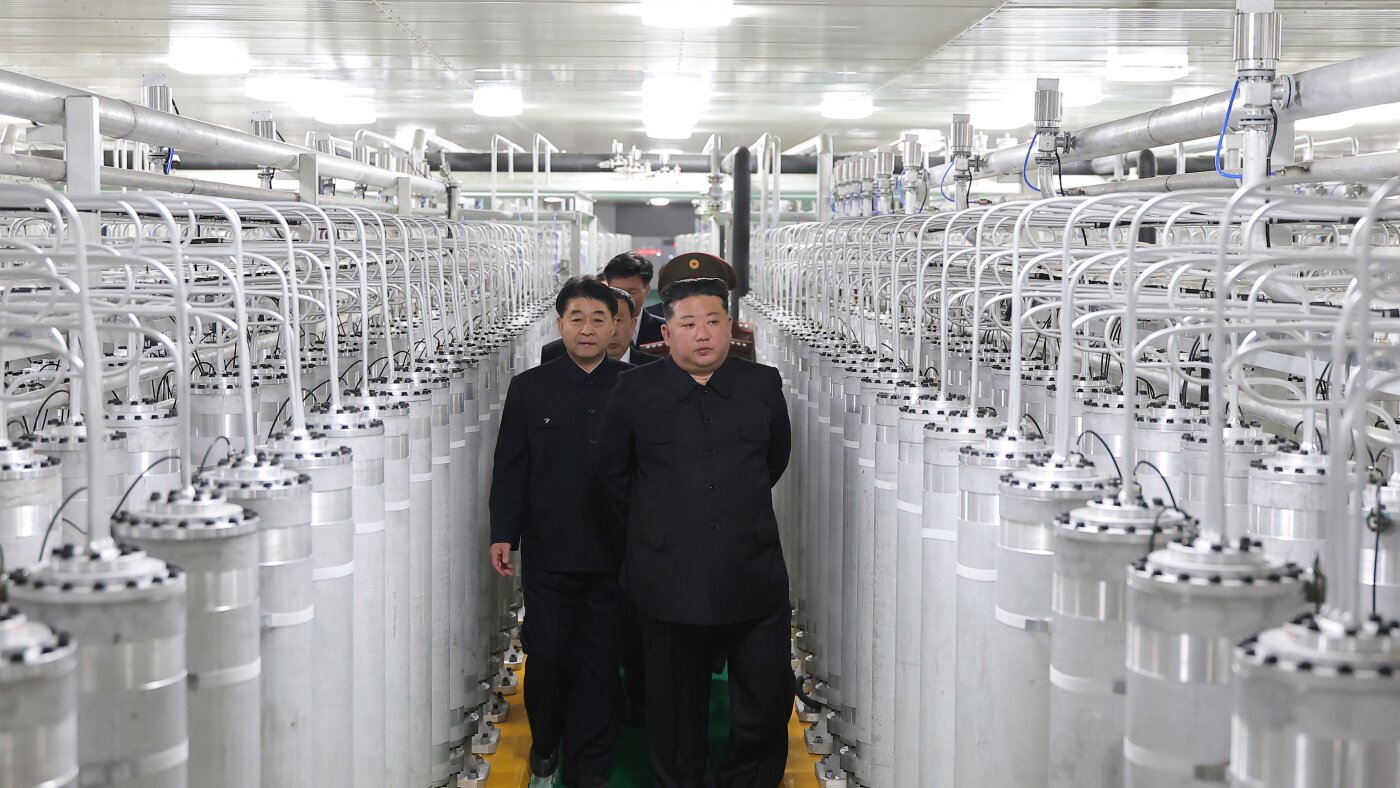
South Korea announced a significant shift in its approach to North Korea’s nuclear program, moving away from a policy that prioritized complete and immediate denuclearization. Speaking on July 23, Unification Minister Chung Dong-young stated that Seoul would now focus first on freezing North Korea’s current nuclear capabilities and advancing weapons production, with negotiations centered on halting further development rather than demanding the dismantlement of existing arsenals as a precondition for talks.
The policy adjustment reflects changing regional dynamics, particularly North Korea’s strengthening relationship with Moscow and Beijing. On July 25, Ukraine’s President Volodymyr Zelenskyy reported that Russia was preparing to deploy an additional 30,000 North Korean troops to support its military operations. The Trump administration has also shifted its rhetorical stance, repeatedly referring to North Korea as a “nuclear power,” and its National Security Strategy notably omitted any reference to North Korea or denuclearization. China has similarly de-emphasized denuclearization in its diplomatic messaging, with President Xi Jinping making no mention of a nuclear-free Korean Peninsula during his June visit to Pyongyang.
Experiments indicate that North Korea has grown increasingly confident in rejecting denuclearization demands. In June, Kim Jong Un’s sister Kim Yo Jong declared that pursuing a stronger nuclear arsenal represents an “irreversible final conclusion” for the country. She subsequently dismissed an ASEAN Regional Forum call for denuclearization, stating the concept had “lost its meaning conceptually and practically.” Analysts note that Kim Jong Un has constitutionally codified the country’s nuclear status, representing his most significant achievement, making reversal politically and militarily untenable.
North Korea’s nuclear capabilities have expanded considerably while international pressure has weakened. The country reported in June that weapons-grade fissile material production capacity has more than doubled over five years. Estimates place its current arsenal at approximately 60 warheads with sufficient material for at least 30 additional weapons. Concurrently, China and Russia have reportedly circumvented sanctions through refined petroleum provision and coal imports, diminishing the financial cost of maintaining nuclear weapons.
Despite South Korea’s pragmatic recalibration, analysts remain skeptical that North Korea will engage in meaningful negotiations. Some experts characterize Seoul’s policy shift as largely rhetorical rather than substantively different from previous approaches. North Korea’s strengthened partnership with Russia and its military contributions to the Ukraine conflict have reportedly emboldened leadership, potentially reducing incentives for negotiations. Russian officials have explicitly advocated for North Korea’s right to maintain nuclear capabilities, with Foreign Minister Sergey Lavrov stating that denuclearization “no longer makes any sense” and is “off the table.”
Article Attribution | Read More at Article Source
Article summary produced by Claude AI